Drones & Fishing- Revolutionary Or Supplemental?
Fishing has evolved significantly over the years, with advancements in technology playing a crucial role in enhancing the fishing experience. One of the most promising innovations in recent years is the use of drones in fishing. Drones, or unmanned aerial vehicles (UAVs), have gained popularity in various fields, from photography to agriculture. In the realm of fishing, they offer unique benefits, including improved efficiency, enhanced safety, and an increased ability to locate fish. This article explores how drones can be utilized in fishing, the benefits they bring, and some practical applications.
Understanding Drones
Before delving into the specifics of drone use in fishing, it is essential to understand what drones are and the types commonly used. Drones are aircraft that can be operated remotely or autonomously, featuring different types of sensors and cameras for various applications. In the fishing industry, two primary types of drones are used:
1. Multirotor Drones: These drones have multiple rotors, providing them with stability and the ability to hover in place. They are particularly useful for short-range flights and can carry cameras, sonar, and other equipment.
2. Fixed-Wing Drones: This type of drone resembles an airplane and is more suited for long-range flights. They have longer battery life and can cover larger areas, making them suitable for scouting larger fishing spots.
Most recreational drones are multirotor drones. The average battery life on a mid-range consumer drone is 20-30 minutes with an average range of 1-3 miles. If you invest in a few batteries you can have some serious flight time without breaking the bank.
How Drones Can Benefit Fishing
Locating Fish- A Perspective Above the Water
One of the greatest advantages of using a drone while fishing is the aerial perspective it provides. Efforts to improve arial perspectives while fishing are not a new undertaking. Tuna towers reshaped what a modern sportfishing vessel looks like as these aluminum structures sought an improved vantage point on a variety of boats. Tuna towers are not just helpful for tuna although they were initially used to hunt bluefin off Bimini in the Bahamas. Tuna towers have evolved and been used on a variety of vessels including smaller center consoles and improve sight fishing abilities for a variety of species including sailfish, mahi mahi, cobia, and more. Inshore, poling platforms and step-up consoles improve the vantage point for tarpon, bonefish, permit, redfish, snook, and more.
The concept of using a plane to take a fisherman’s vantage point to the next level is not new either. Commercial fisherman have used this technique for decades to help locate large schools of fish including tuna, swordfish, bait balls, and more.
Drones now offer a more convenient, compact, and accessible option to improve a fisherman’s vantage point for a variety of applications.
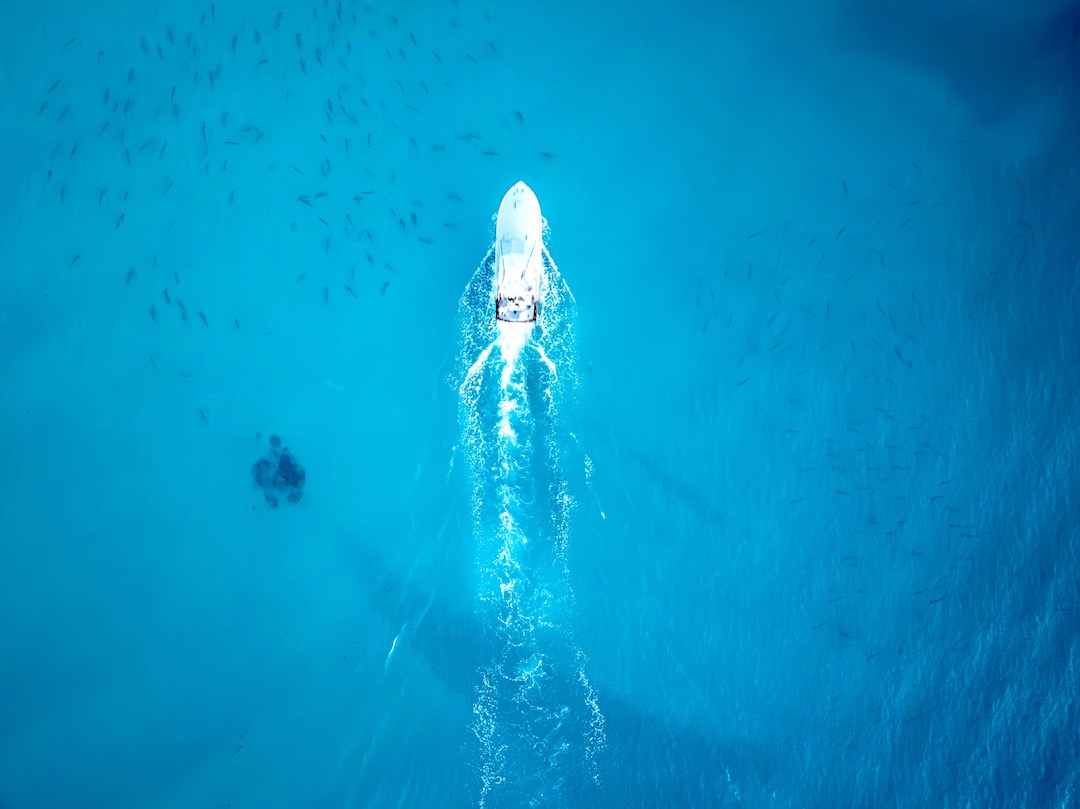 Drone photo of the "Double Threat" near a big school of tarpon off Miami Beach
Locating Fish More Efficiently with Drones
Even the most budget friendly drones come equipped with high-resolution cameras, decent range, and real time feeds to the controller. Our crew has already used drones to spot schools of mullet during their migration which are followed by tarpon, snook, sharks, and more. When surf fishing or on a boat with a long stretch of beach, a drone can help you focus your efforts more efficiently and spot the specific pods of bait that have fish on them.
There are definitely some limitations to spotting fish with a drone. The first issue is that drones require a dedicated operator. If you are fishing alone, you have to either land your drone or spot lock it so it hovers while you fish after spotting something. It is more difficult in practice than in theory especially when you are running along the beach with equipment like cast nets, buckets, and rods in addition to a bulky (and delicate) remote controller. In addition to the requiring a dedicated operator, drone are sensitive to conditions such as rain and excessive wind which can make them difficult or impossible to fly.
Offshore, drones can be used to spot weed lines, temperature breaks, bait balls, and more. They are faster than even some of the fastest boats (at least in terms of average speed when factoring in conditions) but also have significant range and elevation. They can be used to spot schools of tuna in the Bahamas, weed lines for mahi mahi, bait balls while bait fishing, and more. Offshore, drones have their limitations as well. The main issue is that you have to launch and land them from a boat. This is easier said than done with fishing rods, wind, swell, and more making things difficult. Overall, if you aren’t a skilled enough operator or make a simple mistake, it can be costly.
Drones for Habitat Exploration
Half of the challenge while fishing is understanding where to fish. If you can’t spot fish directly, finding promising habitat can help you improve your odds. Underwater features such as sandbars, wrecks, reefs, weed beds, drop-offs, and channels can be effective structure for finding fish. Drones can be a great tool for finding grass beds, wrecks, and more for targeting nearshore species such as grouper, snapper, seatrout, and more. Drones can be used to find structure for lobster diving as well.
Casting & Other Applications
Surf fishermen have been using drones to drop baits far from shore for years now. This can be effective for shark fishing or if you are looking or just looking to get your bait further from shore. For casting, the SwellPro is specifically designed so it can carry up to an 8 pound bait and drop it far from shore. This can save a trip on a kayak (and the need for a kayak entirely) while shark fishing from shore.
There is no doubt that drones will continue to have an impact on fishing. Another application that may see drone involvement is kite fishing on light wind days. When there is no wind boats use helium to suspend kites while fishing for sailfish, especially during tournaments. If someone could design a drone that could be used instead of a kite, this would offer more versatility and flexibility while kite fishing with little or no wind. Nobody has done it yet but who knows what the future has in store.
Drone Content- Amazing Photos and Videos
More than any other application, drones have enabled fisherman to get amazing content while fishing. Having an eye in the sky with high quality cameras allows anyone to explore and shoot content from the shoreline or a boat. Drones have impacted fishing by allowing people to capture incredible photos and videos from perspectives rarely seen before. This trend has had an impact on social media and pushed the boundaries of how fish can be photographed.
‹ Back







Comments