
The yellowtail snapper is one of the easiest reef fish in South Florida to identify and one of the most rewarding to catch. It is the only member of its genus, Ocyurus chrysurus, which sets it apart from the muttons, mangroves, and cuberas that all belong to the genus Lutjanus. Yellowtail have deeply forked, bright yellow tails and a bold yellow stripe that runs from the snout through the eye to the tail, widening toward the back, over a body that shades bluish-olive above and pale below. These are beautiful, great eating fish.
What matters most to an angler is how the fish behaves. Unlike the muttons and groupers that typically hug the bottom, yellowtail school and feed further up in the water column. That single habit is the reason the whole fishery works the way it does, because a heavy chum slick can pull a school up off the reef and hold it right behind the boat, even in a hundred feet of water. Yellowtail also have excellent eyesight, and they shy off a clumsy presentation, so catching them well is a game of patience and a light touch rather than heavy tackle.
Yellowtail Snapper Fishing in Miami
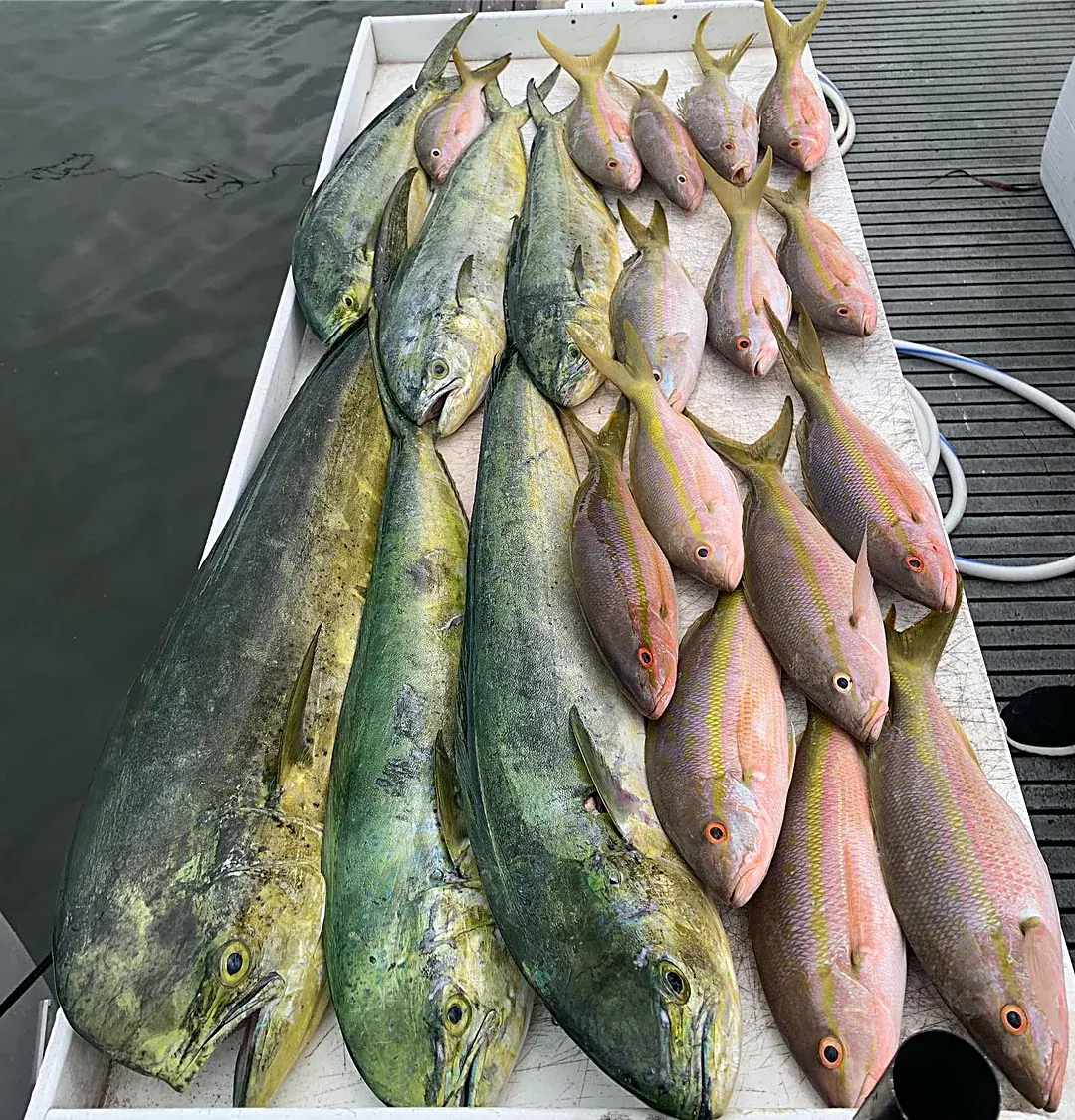
Yellowtail snapper fishing is an enjoyable fishery with one honest caveat: it rewards dedicated effort in the right conditions so it is not viable on every trip. This is not a fish we pick up in passing. When the season and the current line up, a yellowtail trip can be steady, light-tackle action that fills a cooler with some of the best eating in the ocean. When the conditions are wrong, we are usually better off fishing for something else. These fish can be finicky eaters and are sensitive to conditions so it is best to time your windows correctly.
We target yellowtail on our deep-sea trips, because the best reef grounds sit well to the south of Miami. Getting down there, anchoring up, and building a proper chum slick takes time, which is why a yellowtail trip needs at least a three-quarter day, and a full day is often the better call. The extra hours are not wasted. They give us room to run south, set up, and wait out a slow start without burning the whole charter, and they leave time to fish for other species before or after anchoring.
Where Yellowtail Snapper Are Found
Yellowtail are a western Atlantic reef fish. They range from Florida south through the Bahamas, the Caribbean, and on to Brazil, with the occasional fish caught as far north as Massachusetts.1 They live over coral reefs and hard bottom from near the surface down to almost six hundred feet, though the heart of the fishery sits between roughly thirty and two hundred feet.2 South Florida and the Bahamas hold yellowtail in real numbers, and the clean oceanside water along the reef line suits these sharp-eyed schooling fish.
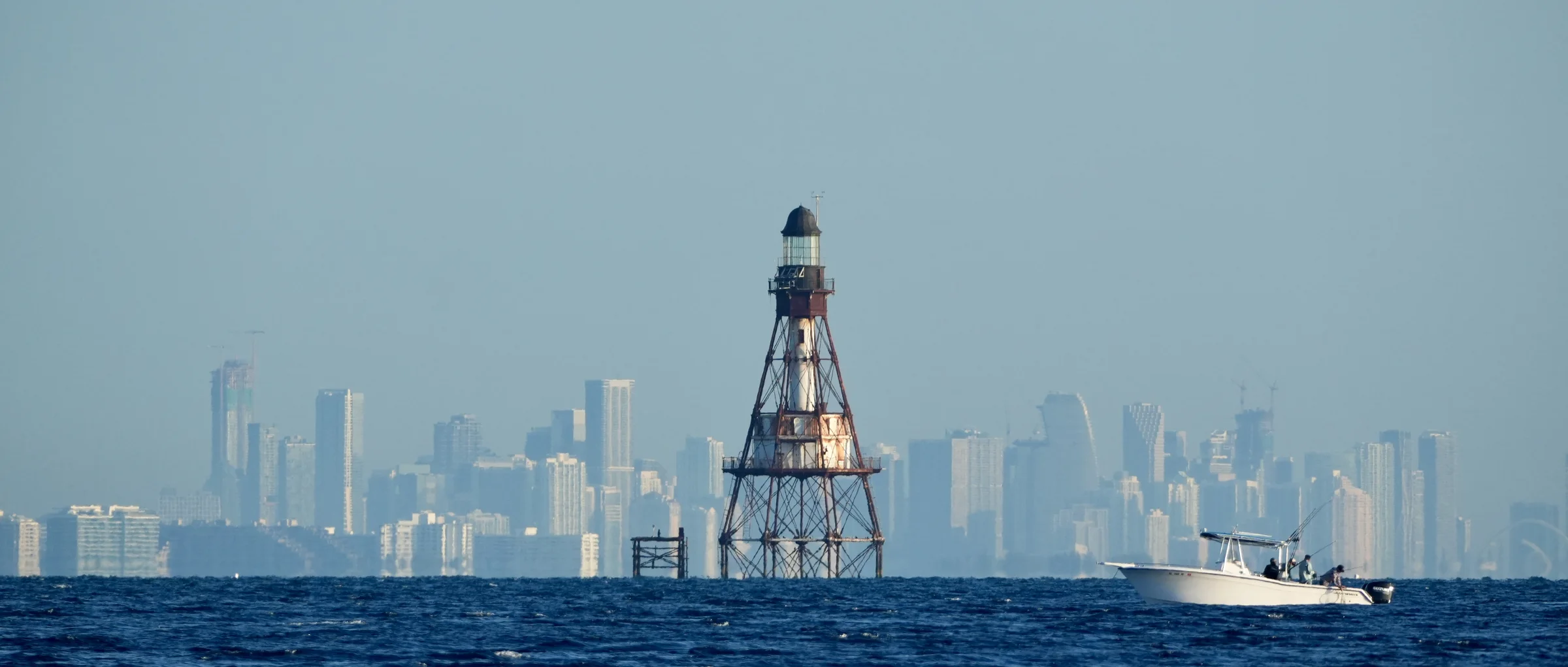
Off Miami we prefer fishing down south. We usually start around Triumph and anchor somewhere between forty and eighty feet of water, depending on the current. Sixty feet of water seems to be the sweet spot with the right current. One thing worth knowing about size: the bigger fish tend to hold a little deeper. You can catch keepers in thirty feet, but the better numbers of large fish usually come from fifty to eighty feet. Snapper grow larger on reefs with less fishing pressure. We catch solid fish down south, and our largest have come from the Bahamas.
Why the Current Matters for Snapper Fishing
The single most important variable in yellowtail fishing is the current, because moving water is what carries your chum away from the boat and out across the reef. The fish will rise up into a slick, but you still have to get the chum down to them to get them feeding.
We like ¾’s of a knot of north current — the window where the slick forms cleanly and the fish commit. You can push it up to roughly 1.5 knots by adding jig heads, chumming more aggressively and using sand balls to get baits down, but if the current gets faster, it can become genuinely difficult. If the current is smoking, try anchoring shallower in say 40 feet rather than 60 feet so you can get the fish engaged a bit more. On the slow side, anything down to a half knot is workable as long as there is some movement, and we tend to fish a little deeper when the current is light. Once it drops below about a quarter knot, or goes slack, it is time to do something else, because the slick will not flow as well and it is hard to get the fish to eat.
Overall we prefer fishing for yellowtail on calm days. Yellowtailing involves anchoring on the reef for hours, and flat water keeps the boat comfortable on the hook.
How to Catch Yellowtail Snapper
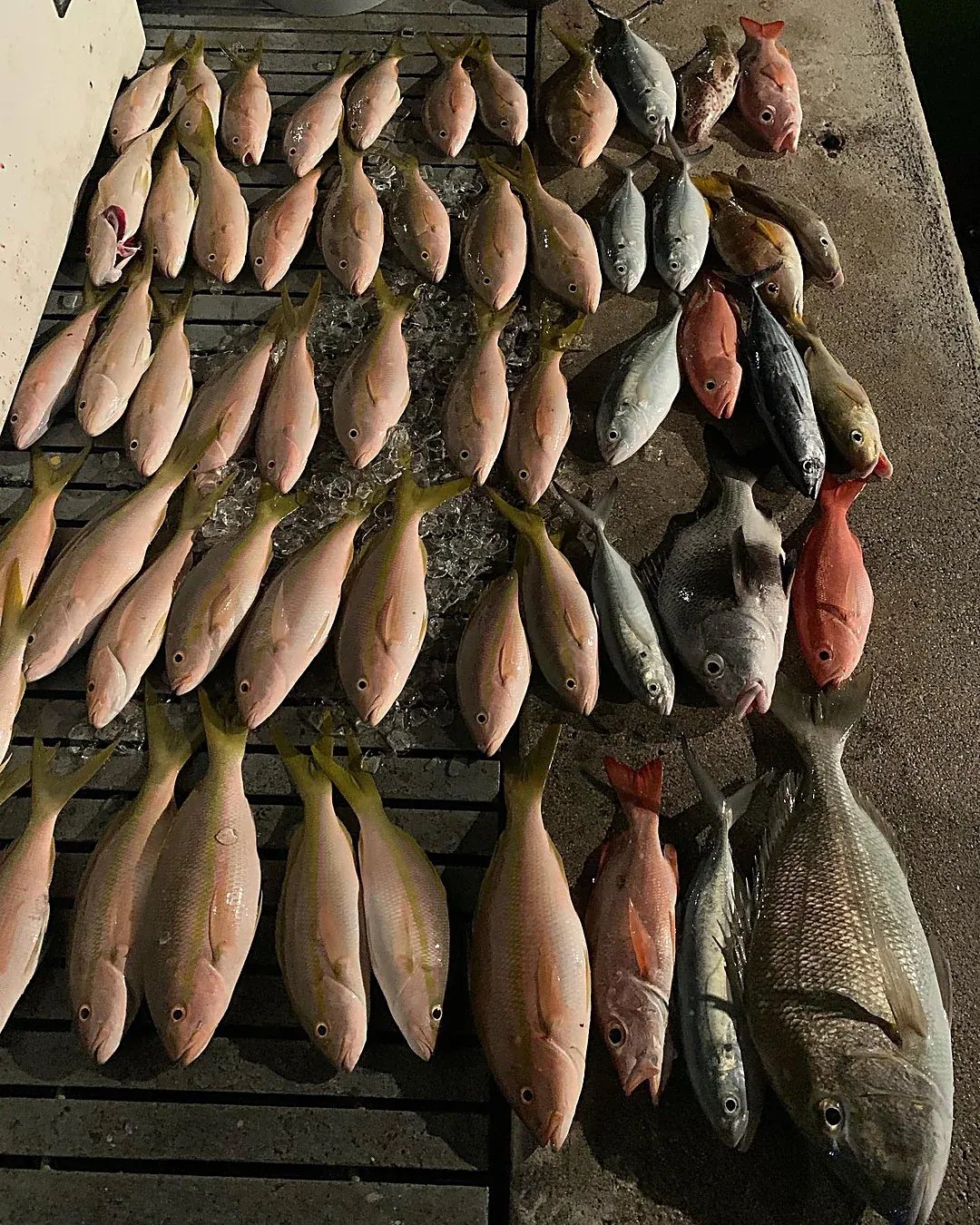
Catching yellowtail comes down to three things done right: anchoring cleanly over the reef, building a heavy chum slick, and presenting a bait so naturally that these wary fish never think twice.
Anchoring on the Reef
Yellowtail fishing means anchoring on hard reef bottom, and that is a skill in itself. We use a five-prong grapnel anchor, which is the right tool for rocks, where a more expensive sand anchor either will not grab, gets stuck, or comes up bent. We rig the grapnel anchor breakaway-style, with the chain tied to the bottom of the anchor and run up the shaft, held in place near the top by a single zip tie. In normal use we hold and retrieve off the shaft like any anchor. When it snags the reef, a hard pull snaps the zip tie, the load shifts to the bottom of the anchor, and it backs out the way it went in instead of staying buried.
We pair the anchor with a detachable buoy retrieval system. This is essentially a float style fender connected to the anchor rode with a large carabiner that slides down the anchor line under the boat’s power so the buoy can lift and pop the anchor free, which helps it float to the surface. This lets us recover the anchor without pulling against the weight. It is important to carefully drive around the anchor and up current while still connected to the bottom when you deploy the buoy. The current and driving is what pushes the float down to help pull the anchor up to the surface. The whole rig is cheap to rebuild, so even on the rare day we lose one, it costs a few dollars rather than your expensive primary anchor.
Building the Chum Slick
Yellowtail will not usually come to a thin slick, so we do not bother with anything less than six blocks of chum (tournament chum works well and comes in cases of 6) and a bag of oats if we are going to try for them. The mix lives in a trash can or large bin, rather than a five-gallon bucket, which is too small for the job. On the run out to the grounds, we usually put one block of chum in the trash can with 5 gallons of saltwater and add some oats so it can thaw and mix. The oats are a good trick because they add volume and cloud the water behind the boat, which gives the fish cover and gets them biting even when the water is gin clear.
Once we anchor, we hang one chum bag off the stern for steady baseline flow, then ladle the garbage can mix back by hand every thirty seconds or so, spraying it with a hose and stirring with the ladle to keep it blended. Then we wait. It usually takes about fifteen minutes of patient ladling before a real slick develops and the school rises into it. There is no shortcut, and rushing is usually just a waste of effort. Continue adding a new block of chum to the trash can mix as needed with more oats, usually one block per hour is enough for heavy chumming. Between the chum bag off the transom and the trash can mix, you can aggressively chum for 3-4 hours with 6 blocks. By this time you will have your limit, or know that they aren’t biting by hour 2 and you can move on to something else.
The Free-Spool Drift
With the slick working and the fish up behind the boat, the actual fishing is simple to describe and easy to get wrong. You open the bail, drop a bait into the slick, and let it free-spool back with the current for a few minutes, drifting naturally among the chum. Any tension at all, caused by a closed bail or too much drag, stops the bait from drifting like the chum, and a yellowtail will refuse it. If a bait drifts untouched well past the school, reel it in, put on a fresh one, and send it again. We sometimes free spool almost to the end of our spool at the beginning to get back to the fish.
The bite is the fun part. You sit there with the bail open and the line slowly paying out, and then it suddenly starts ripping off the spool. You close the bail, the rod loads up, and a fish that fights well above its size makes a hard first run powered by that oversized tail. On light spinning tackle it is a genuinely good fight, and it is the reason yellowtail are such a satisfying fish for anglers of every level.
Sharks and Barracuda
Anchoring and chumming over a reef draws predators, and they are part of the game. It is not only sharks. Barracuda can be just as much of a problem, sometimes worse while yellowtailing. The issue is the fight, because a fish hooked far back in the slick has to be fought all the way to the boat, which gives a shark or a barracuda time to grab it. The first and best answer is more chum, because the harder we work the school up close to the boat, the sooner a fish is hooked and the shorter the trip to the boat. A short fight is usually a landed fish.
When predators crowd in, they also spook the school itself, and the yellowtail get nervous and slide back down toward the bottom. If one big barracuda is sitting behind the boat, we will try to catch it and move it along. If there are too many to manage and the bite shuts down, we pull the anchor and move. And when we simply need to get fish past the predators faster, we will step up from light spinners to heavier spinning gear to shorten the fight.
Best Rigs and Bait for Yellowtail Snapper
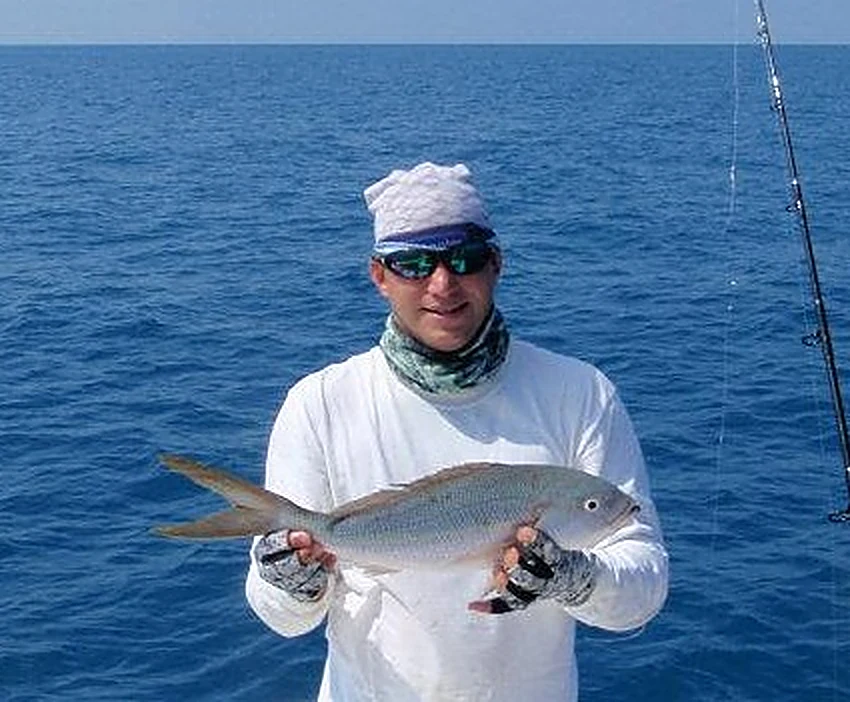
Yellowtail fishing is light-tackle fishing, and the tackle reflects how wary the fish are. We fish spinning gear with about a twenty-pound fluorocarbon leader, light enough that a sharp-eyed snapper does not shy off it. You can even scale down to 10lb if you really need to but you may lose some fish that get chafed off. In light current we often fish a bare hook so the bait drifts as freely as possible. As the current picks up, we add a jig head scaled to the flow, up to about a half ounce, just enough weight to carry the bait down into the strike zone without killing the drift.
For bait, silversides are our top choice with shrimp, small pieces of bonito or barracuda skin, ballyhoo chunks, and squid, all working well. The same rig works for small fish and for “flags,” the name used for the large yellowtail over about eighteen inches. The difference between an average fish and a big one is not the bait or the rig. It is location and a well-developed slick, because the bigger fish hold a touch deeper and grow bolder as the school competes for the chum.
Yellowtail Snapper Fishing Charters in Miami
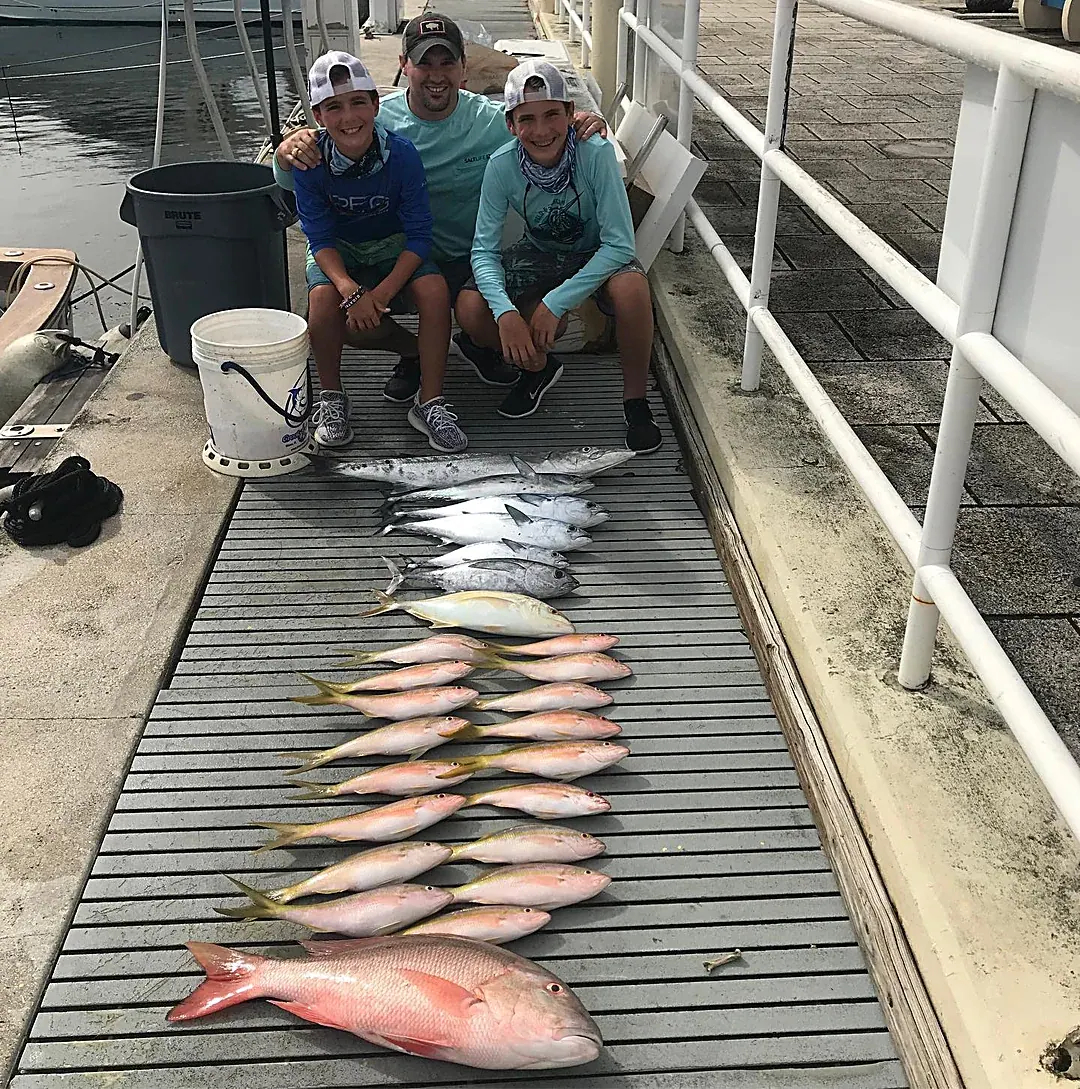
Yellowtail are prized at the table for good reason. The fillets are mild, and white, among the better eating of any snapper. The fillets are a bit delicate so it is best to make sure you get them into a brine quickly, and when you fillet or clean them make sure the meat does not touch fresh water and stays cool.
A yellowtail trip with us is the family-friendly side of offshore fishing: steady action, light tackle, and a cooler of fresh fillets at the end of the day, with the honest understanding that we only try for them on longer trips when the season and conditions are right. June through September is the peak window, though we catch them nearly year-round when the current cooperates, because good conditions in spring will always beat poor conditions in summer. If reef and bottom fishing is what you are after, yellowtail snapper pairs naturally with mutton snapper and the other reef species on the same grounds. Reach out and we will help you pick the right trip, and the right day, to put a school of tails behind the boat.
Range and distribution per the Florida Fish and Wildlife Conservation Commission and FishBase data for Ocyurus chrysurus. ↩︎
Depth range per FishBase; most fish hold between roughly 10 and 70 meters. Maximum recorded length is about 34 inches and the heaviest recorded weight roughly 11 pounds; the Florida state record is 8 lb 9 oz. ↩︎