
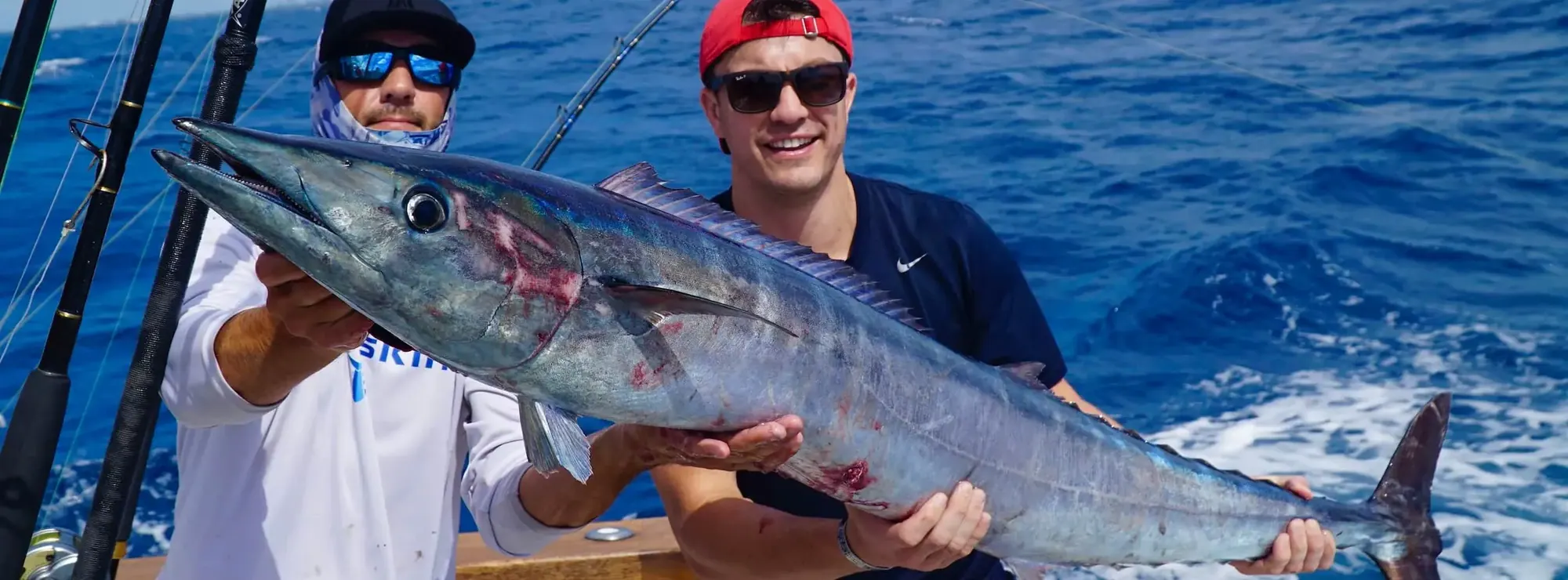
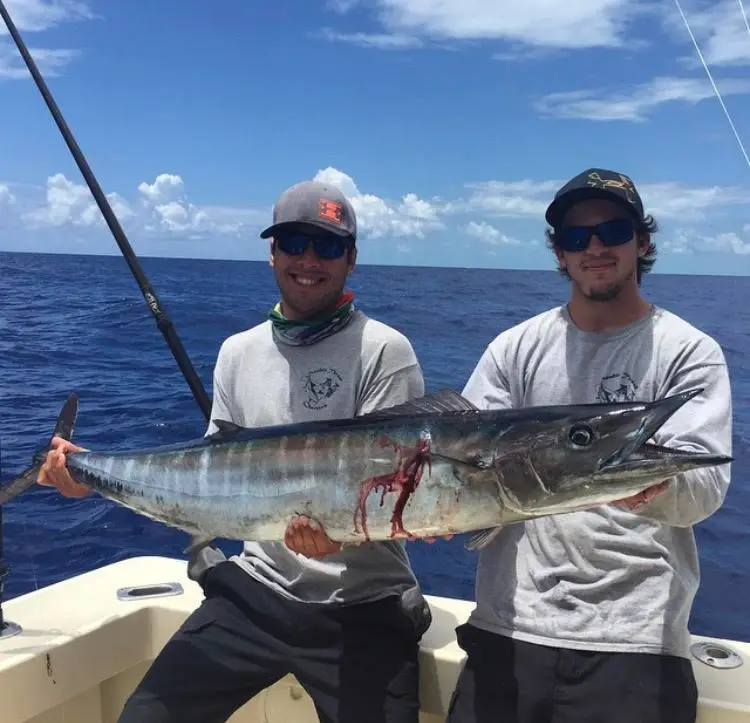
Wahoo are built for speed and disguise. The speed comes from a long, tapered body shaped like a missile, and the disguise comes from neon blue tiger striping that works as deep-blue-water camouflage. You can see a wahoo right at the surface, but as one fades a few feet down it all but disappears, even in clean water. They carry excellent eyesight, razor-sharp teeth, and a reputation for being finicky. Off Miami they average about 20 to 50 pounds, with smaller fish showing under floating debris and the bigger fish out on the edge. They are one of the fastest fish in the ocean, and they are caught here on their terms, not ours.
Wahoo Fishing in Miami
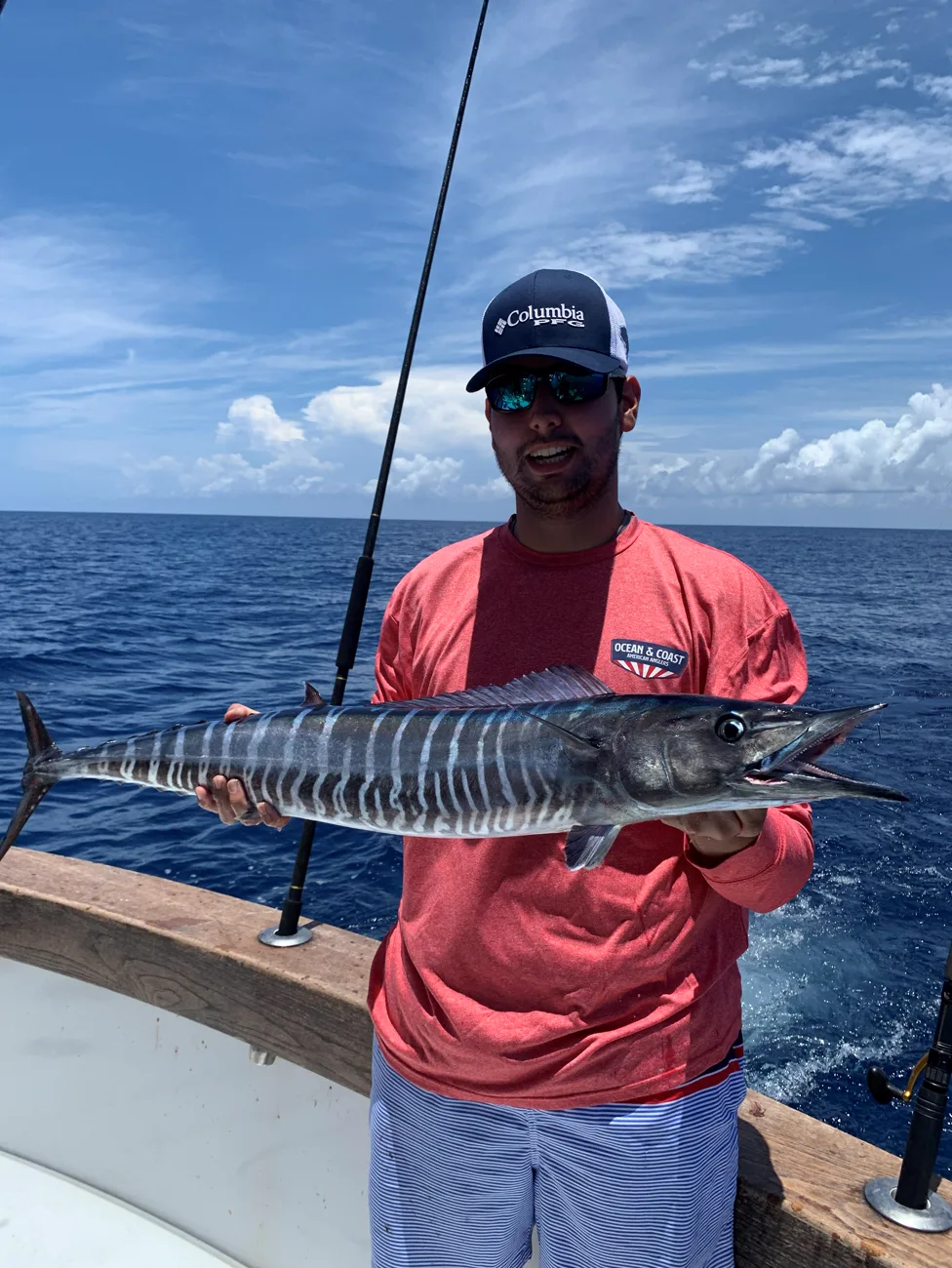
Miami is not the wahoo capital of the world, but they do move through our waters. When the Gulf Stream pushes in tight to the edge with a hard north current, wahoo are one of the many species that become much more likely to show. We catch most of our bigger wahoo on the planers in 150 to 400 feet of water, but we have also caught plenty of nice fish on the kites. Wahoo are a treat rather than a consistent option for us, because even on the best days of wahoo fishing, one or two fish is all you might encounter. We have caught 10 or more “weehoo” in a day under floating debris further offshore, but those are sub-20-pound juvenile fish. Our best day on sizeable fish was three wahoo in the 30 to 50 pound range, caught planer fishing. Compared to double-digit days in the Bahamas, this is not a world-class wahoo fishery, but we do catch our share. The main challenge here is consistency. We catch them here and there, and we also have long stretches where we may not see a wahoo for weeks or months. That is partially because we do not target them as specifically as we could, and partially a reflection of how sensitive they are to conditions.
Where Wahoo Show Up
There is usually a correlation between a fish’s coloring and the water it lives in. Wahoo have the colors of clean, deep blue water, so finding them starts with finding that water. The west wall of the Gulf Stream fluctuates off South Florida; some days the bluer water and current start in 80 feet, and some days they sit in 1,000. Wahoo follow that current and the bait. There is no real limit to the depth they will travel, but as a rule, the bigger ones like to hold near reefs and drop-offs in the 150 to 600 foot range. You can definitely catch them deeper, but banks and drop-offs adjacent to deep water with current seem to be the near universal wahoo habitat across the Caribbean.
The moon is a factor for wahoo fishing, but you don’t live and die by it. A big moon usually gives you more for your time, but you can catch wahoo off-moon, and a new moon can be almost as good as a full one. The mechanism matters more than the calendar. A big moon means stronger tides, and stronger tides both help push the Stream in closer and move water and bait around, which gets wahoo feeding. Many Bahamas banks have no Gulf Stream current at all, so over there the tide does much of the water-moving work. Off Miami the Stream and the tide are both factors we consider. The big tides that come with a full or new moon can create hard edges and color changes that help you concentrate your effort. As for the calendar, fall is probably the best time of year overall for wahoo off Miami.
How We Catch Wahoo in Miami
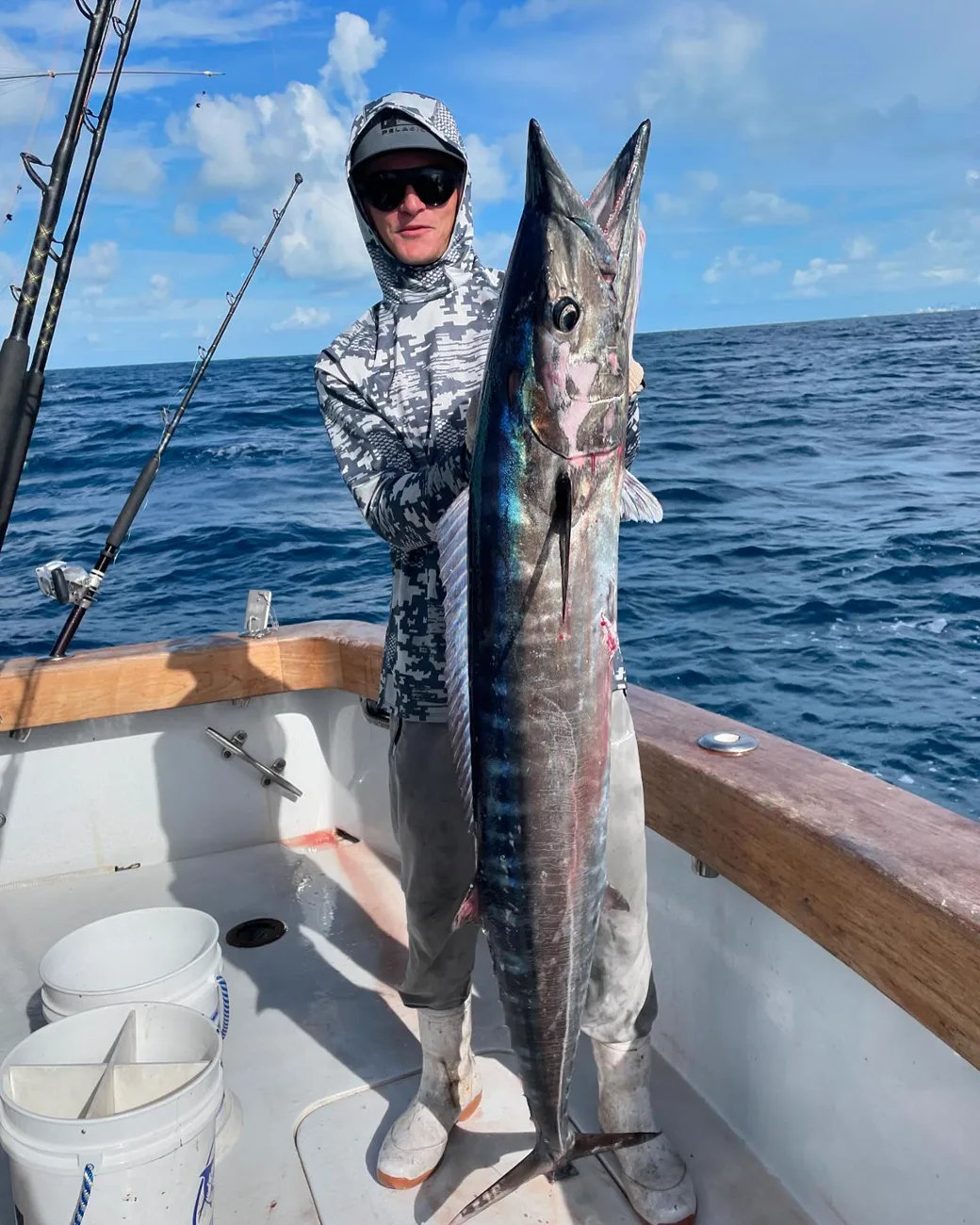
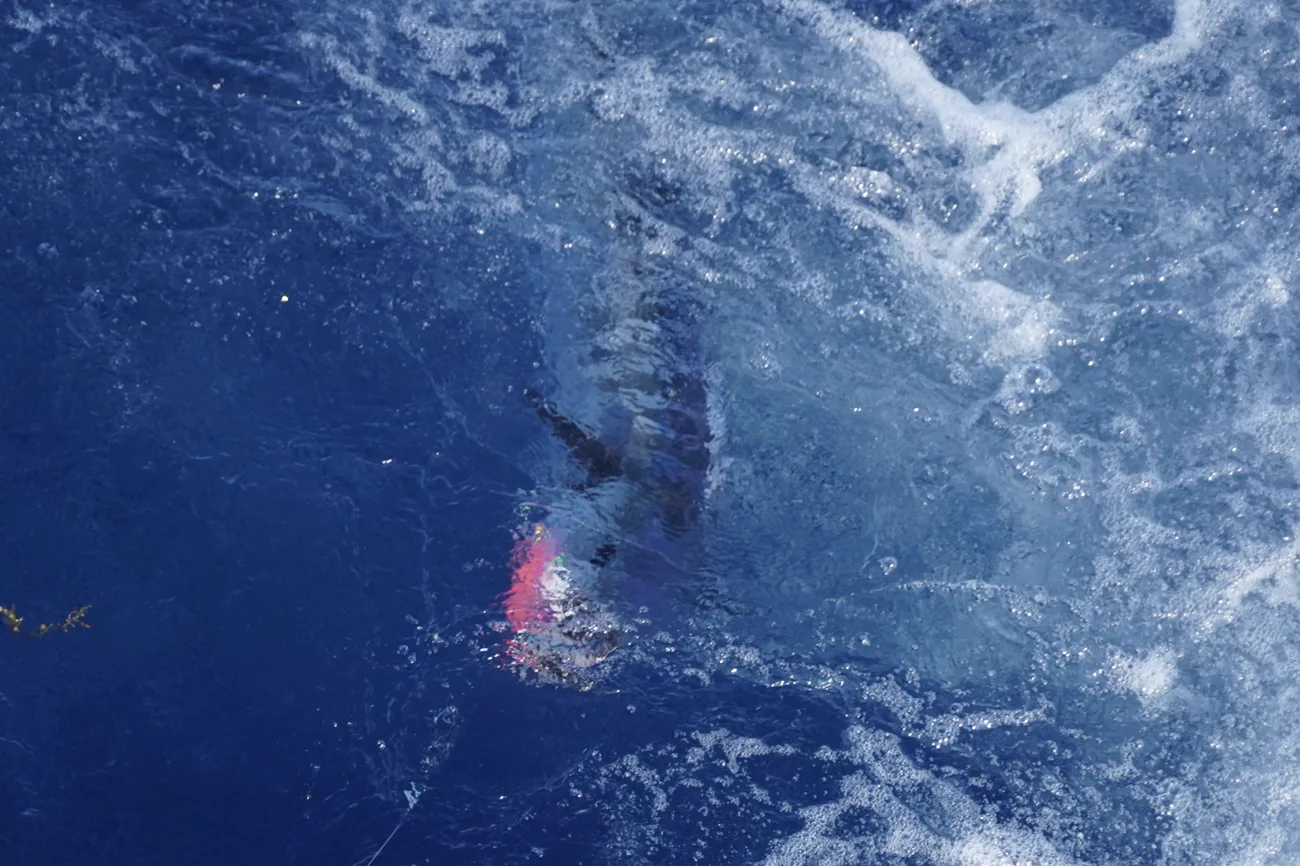
Most boats from Miami to Palm Beach catch the bulk of their wahoo on the planers. This is our go-to as well, because a planer spread lets you cover ground more thoroughly than high speed trolling. Planers allow you to work specific drop-offs, areas holding bait, wrecks, and more, and the best part about planer fishing is that you can catch wahoo in addition to other species. We deploy two planers running 20 to 50 feet down, pulling strips under sea-witches or drone spoons, and we usually stick to slightly deeper water when wahoo are the focus, 150 to 350 rather than the 80 to 150 we work for kingfish. We typically troll a mix of four ballyhoo and feathers on the surface as well while planer fishing, so our spread covers more of the water column. The same planers that produce wahoo keep producing kingfish, blackfin tuna, and more. Trolling large swimming plugs and swimming ballyhoo gets their attention too, though the bites come fewer and farther between.
Leader choice involves a real cost-benefit analysis. We usually run roughly 50 feet of monofilament leader on the planer rods because mono draws more bites. A trace of wire or cable prevents cut-offs, and it calms the nerves when a big wahoo eats, but the bite count drops with it, especially at the slower speeds of planer fishing. High speed trolling is more friendly toward cable and wire leaders.
We have caught (and lost) plenty of nice wahoo on the kites, even though they are not the target species with this technique. We usually fish monofilament leaders with circle hooks because sailfish are often the target, and you would be surprised how many wahoo and big kingfish come over the rail without wire, hooked clean in the corner of the mouth. If the toothy fish are thick, we often switch to wire or titanium leaders and send out big blue runners, goggle eyes, or herring to improve our odds.
Under floating debris, wahoo hold deeper in the column than the mahi above them. Dropping a dark jig a few hundred feet down and ripping it toward the surface is one of the most reliable ways to draw a strike, and the planers can produce under debris as well. Expect these wahoo to average just 10 pounds; they are typically juvenile fish.
High Speed Trolling for Wahoo
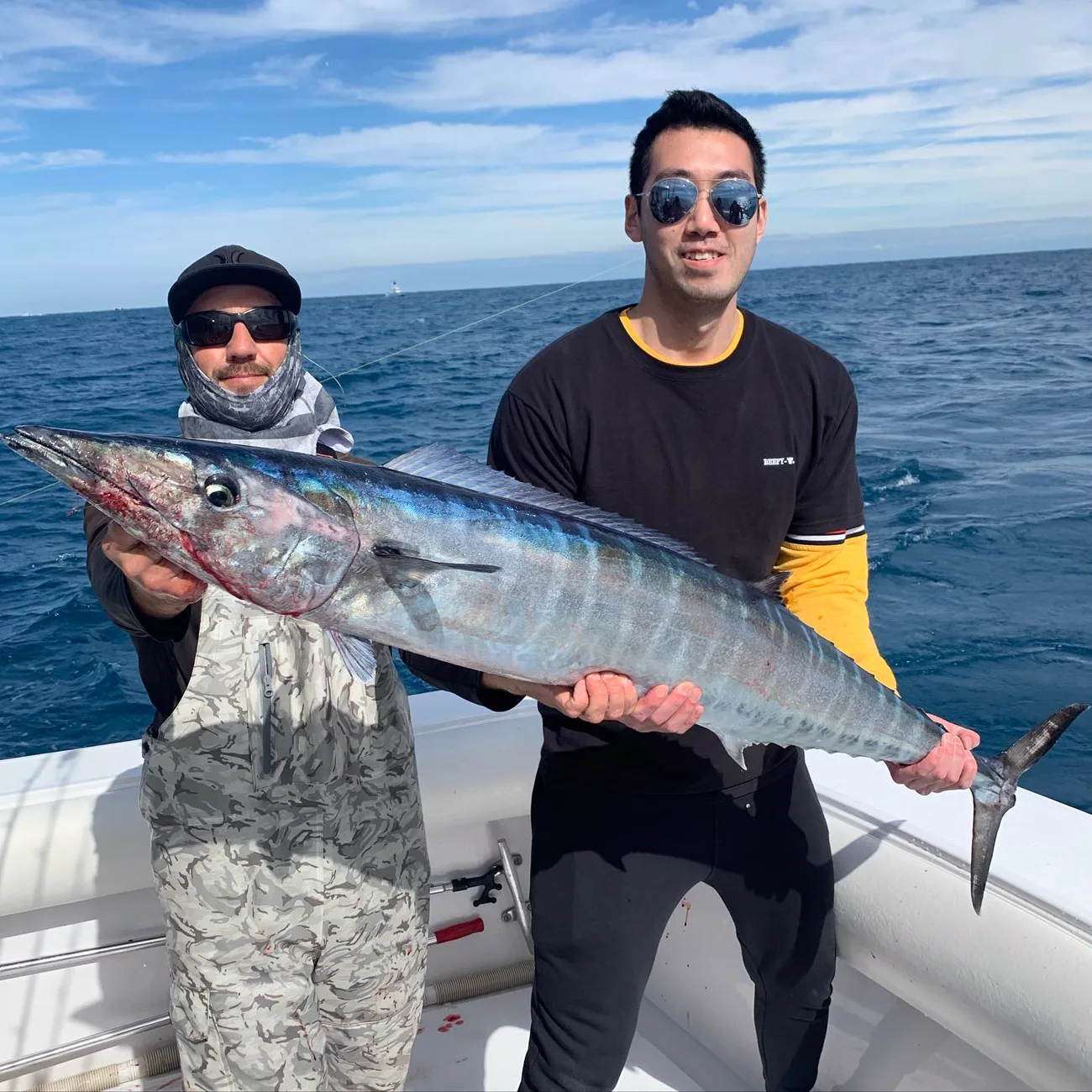
High speed trolling is one of the most effective wahoo techniques in the world, and it deserves to be understood on its own terms. Wahoo have no problem running down a bait moving 12 to 18 mph. While high speed trolling, crews deploy three to five lines staggered behind the boat, pulling 10 to 15 inch lures rigged on cable with stout single or double J-hook rigs, each behind a weighted head or a 1 to 3 pound cigar lead that keeps the lure in the water at speed. Dark colors show best in the white wash. The technique shines over strong current and sharp drop-offs, generally in 200 to 1,000 feet of water.
Where the water is loaded with wahoo, nothing beats high speed trolling, especially when you factor in the extra ground you cover. On a good bite in the Bahamas, you can catch 10 or more wahoo in a day while high speeding, and bycatch stops mattering because you have a pile of wahoo.
We do not high speed troll off Miami, and very few boats do it off South Florida in general. Stateside, we do not have the same number of wahoo, and high speed trolling turns what could be a great multi-species day into an all-or-nothing bet on a fish that is not as abundant here. We do make single-technique commitments, but only when a species cannot be caught any other way. Swordfish is that kind of fish; you will not pick one up incidentally unless you are daytime or nighttime swording. Wahoo fail that test in the best way possible. A nice wahoo can still be caught off the planers, off the kite, and on a jig under debris, so we keep our options open and let the wahoo come as part of the day. There are certain moon phases and conditions during certain parts of the year where boats do have some success high speed trolling off South Florida, but for us the juice isn’t worth the squeeze. Planer fishing can provide similar opportunities without the same likelihood of catching nothing at all.
How Wahoo Fight
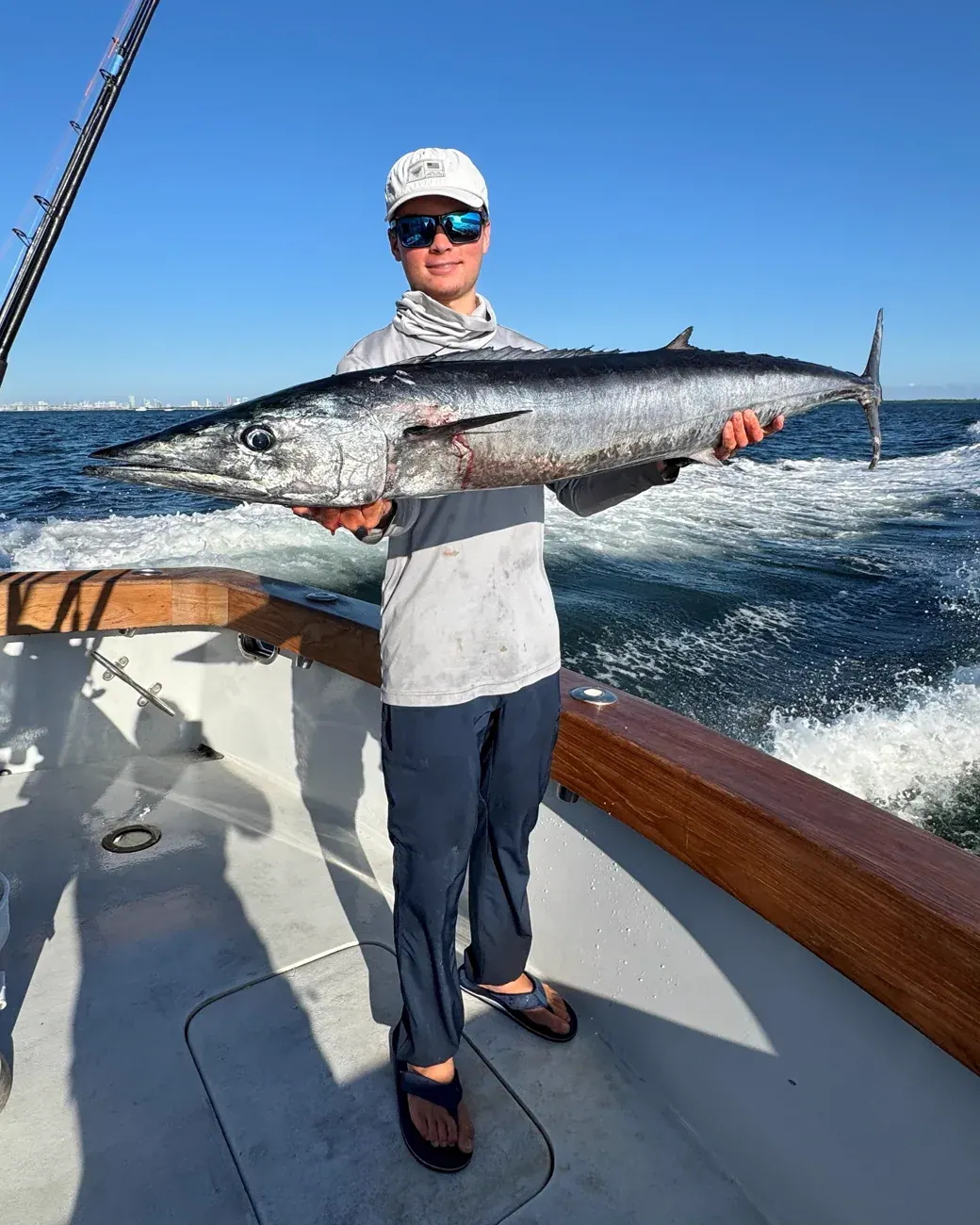
A wahoo can hang nearly motionless in the water column and reach a full burst of speed in the blink of an eye. Big fish often hold below schools of bonito, blackfin tuna, and flying fish. They slice through their prey with surgically sharp teeth, and usually circle back to gobble up the sinking remains. On the rod, the first run from a wahoo is a screamer. A wahoo fights something like a big kingfish, but the initial run is in a different class. Their mouths are hard as rock, so sharp hooks are a must, and the constant head shaking will throw a dull hook that has not found a real hold. Their camouflage works all the way to the boat. The fish blends seamlessly into dark blue water until it turns on its side and the stripes finally give it away.
Wahoo Fishing Charters in Miami
We fish for wahoo when the water tells us to. We like to see blue water on the edge, a north current, and big tidal swings. Mix that water with a lot of bait or a decent time of year, and it can improve our odds. If you put in the time under the right conditions, you can usually put one or two fish in the boat. Wahoo tend to come to us as part of a mixed-bag offshore day alongside kingfish, blackfin tuna, sailfish, and mahi. We would not book a trip only to catch wahoo, but they are always out there, so there is no reason to rule one out either.