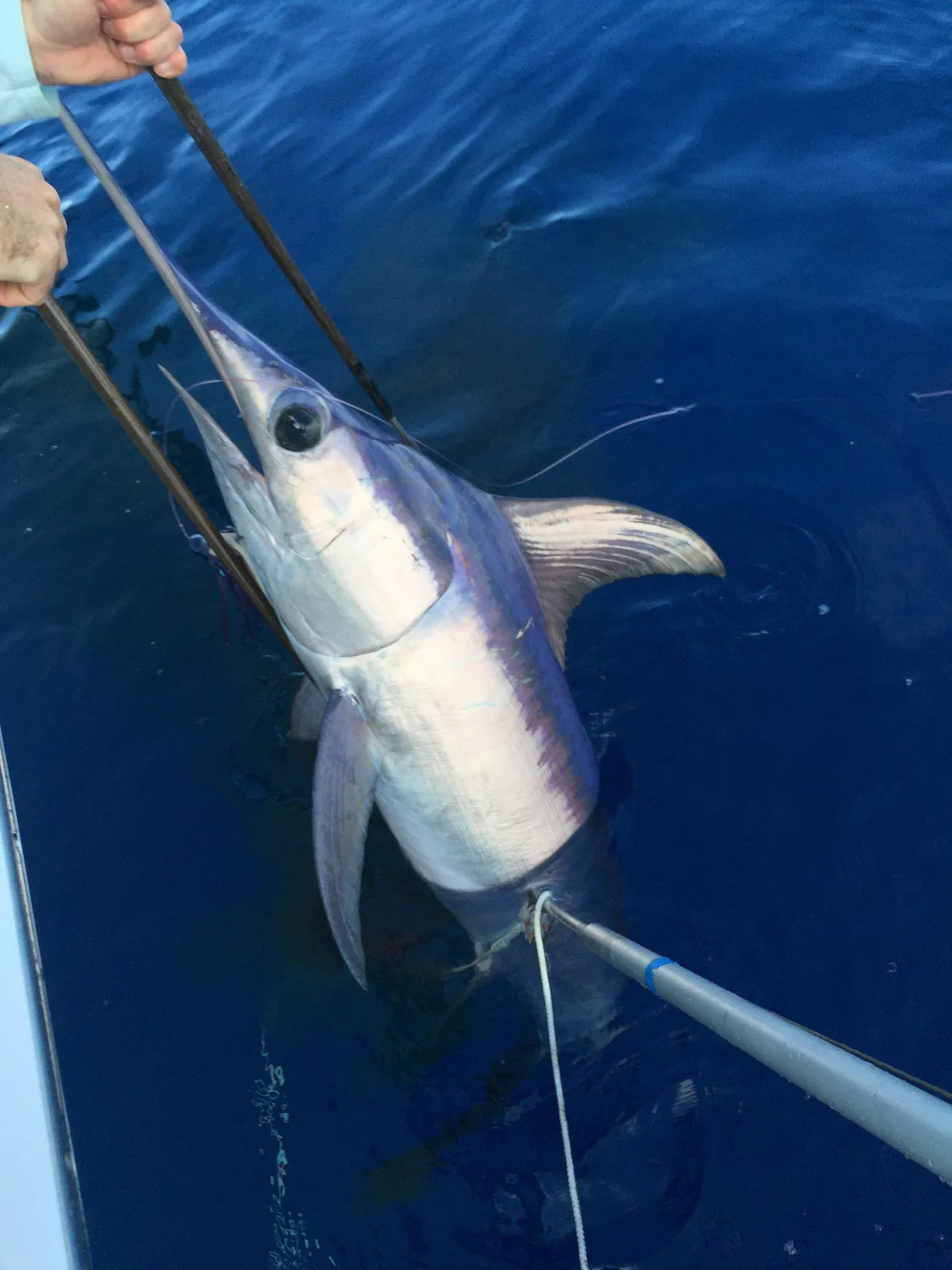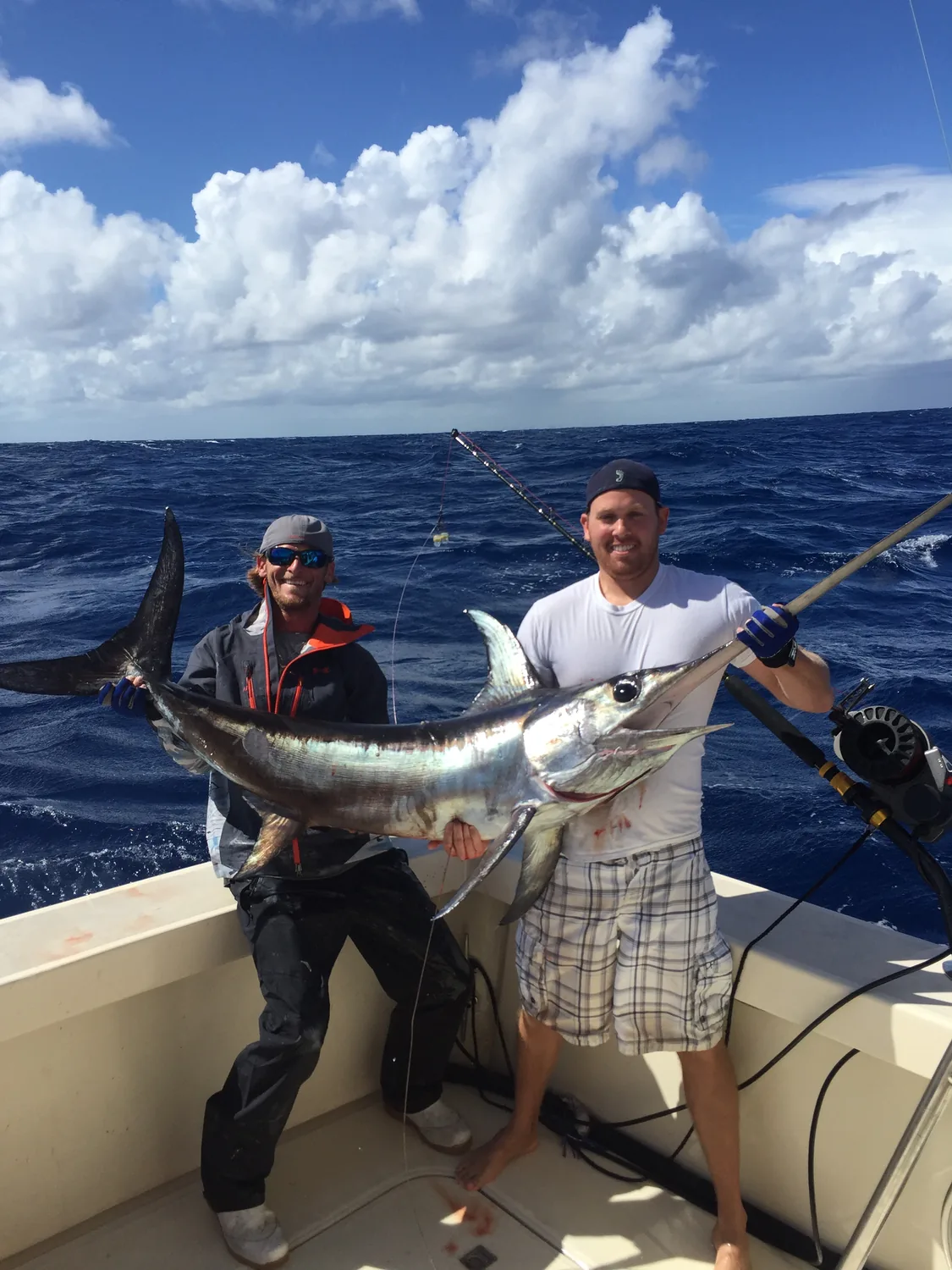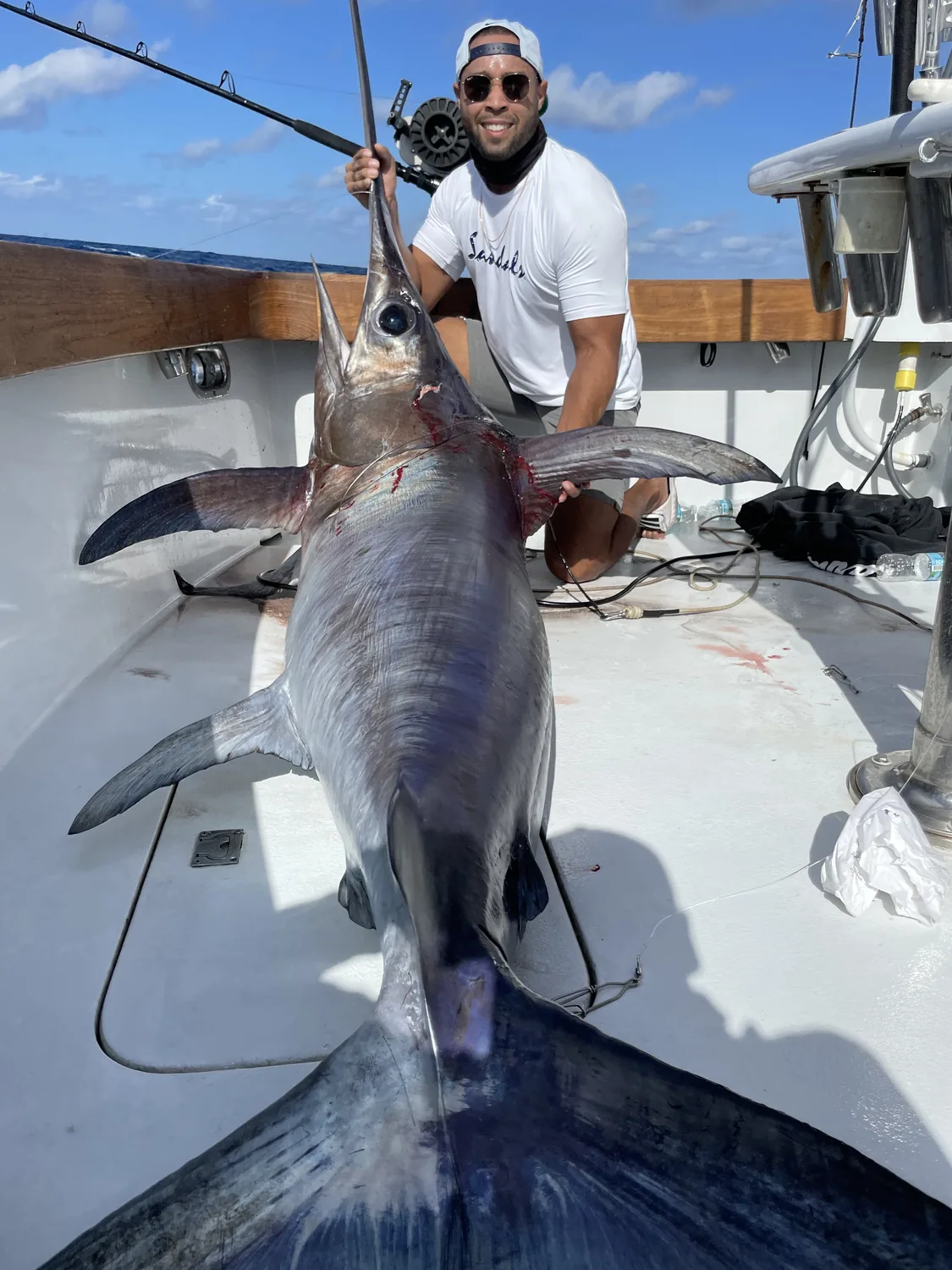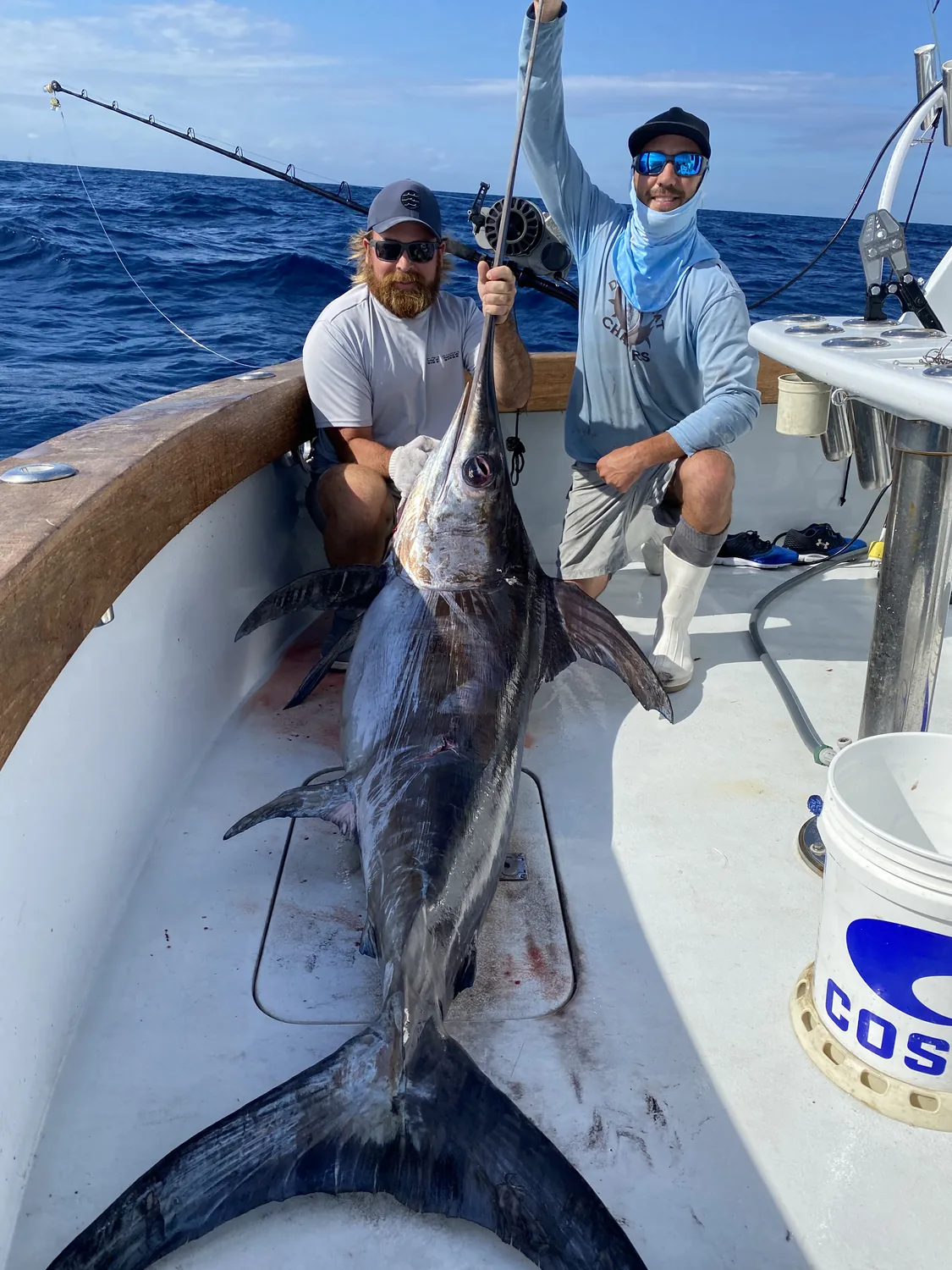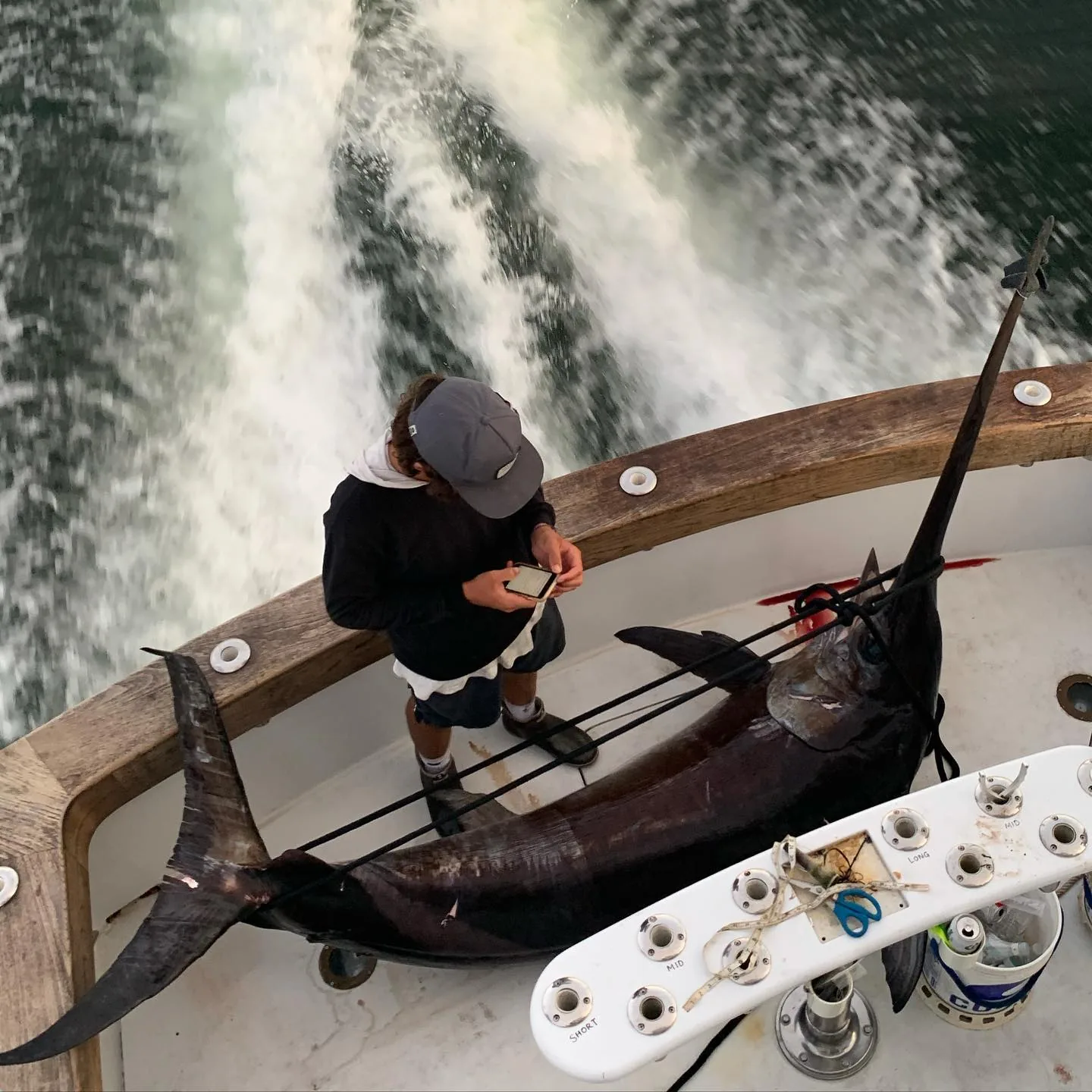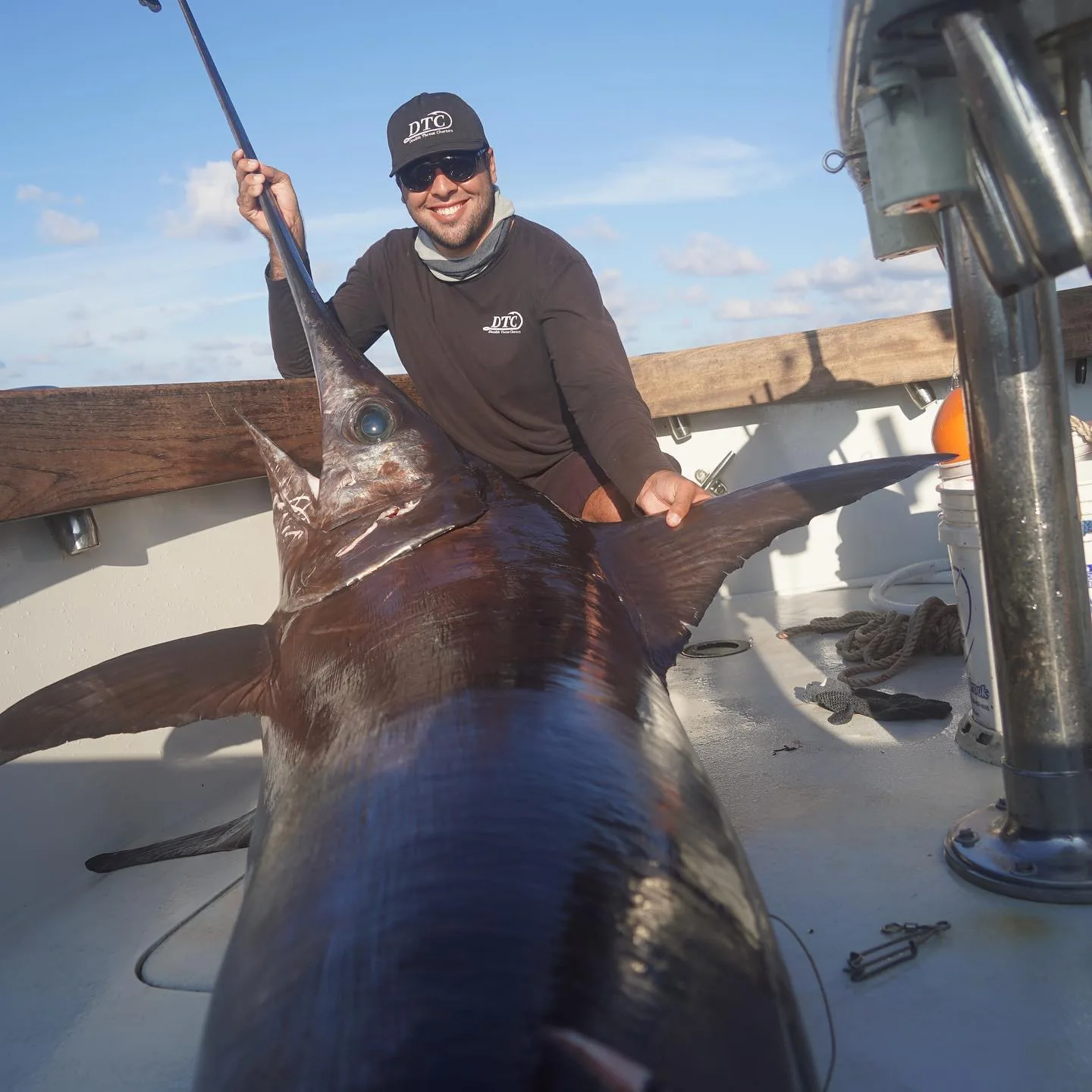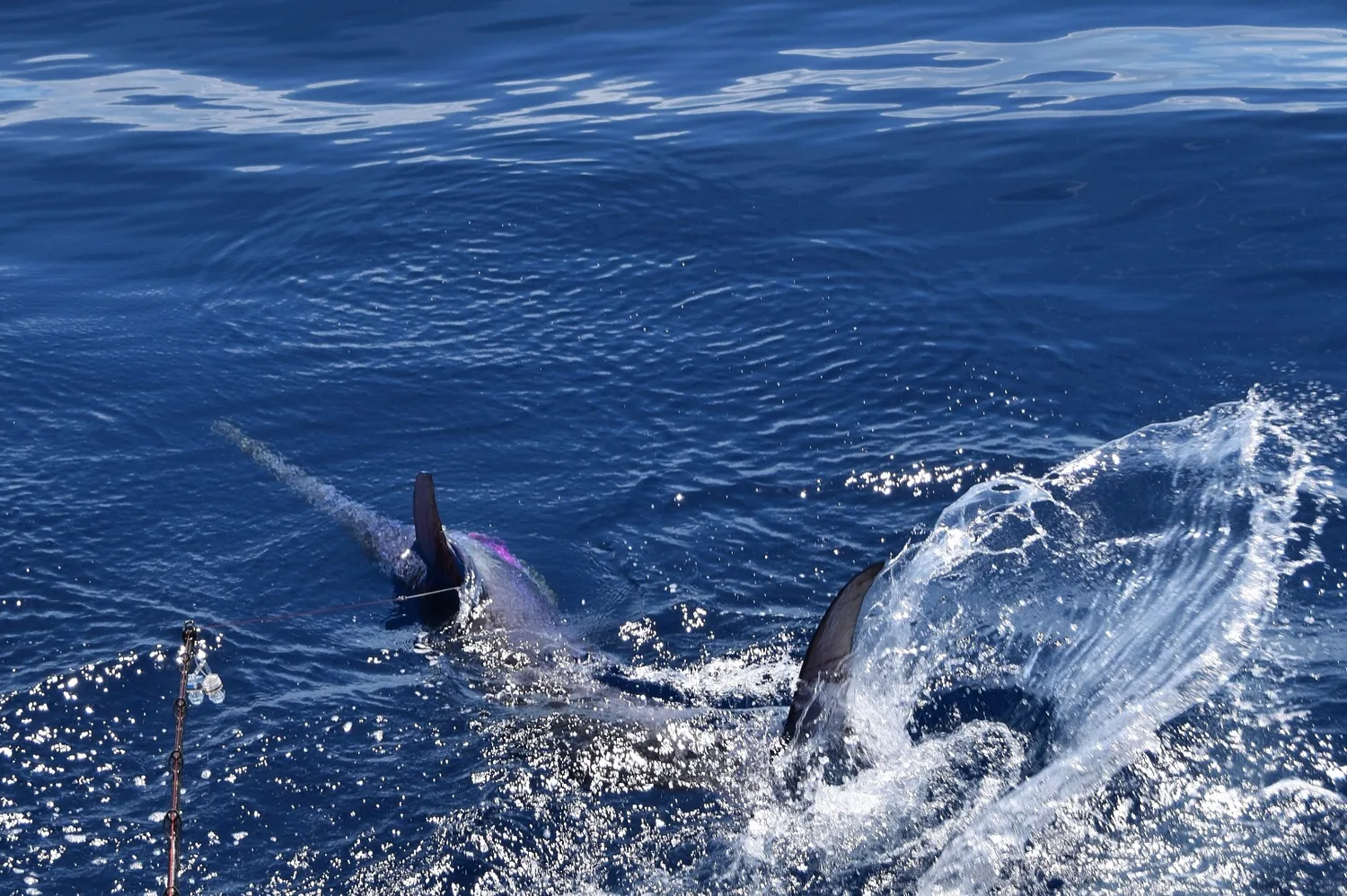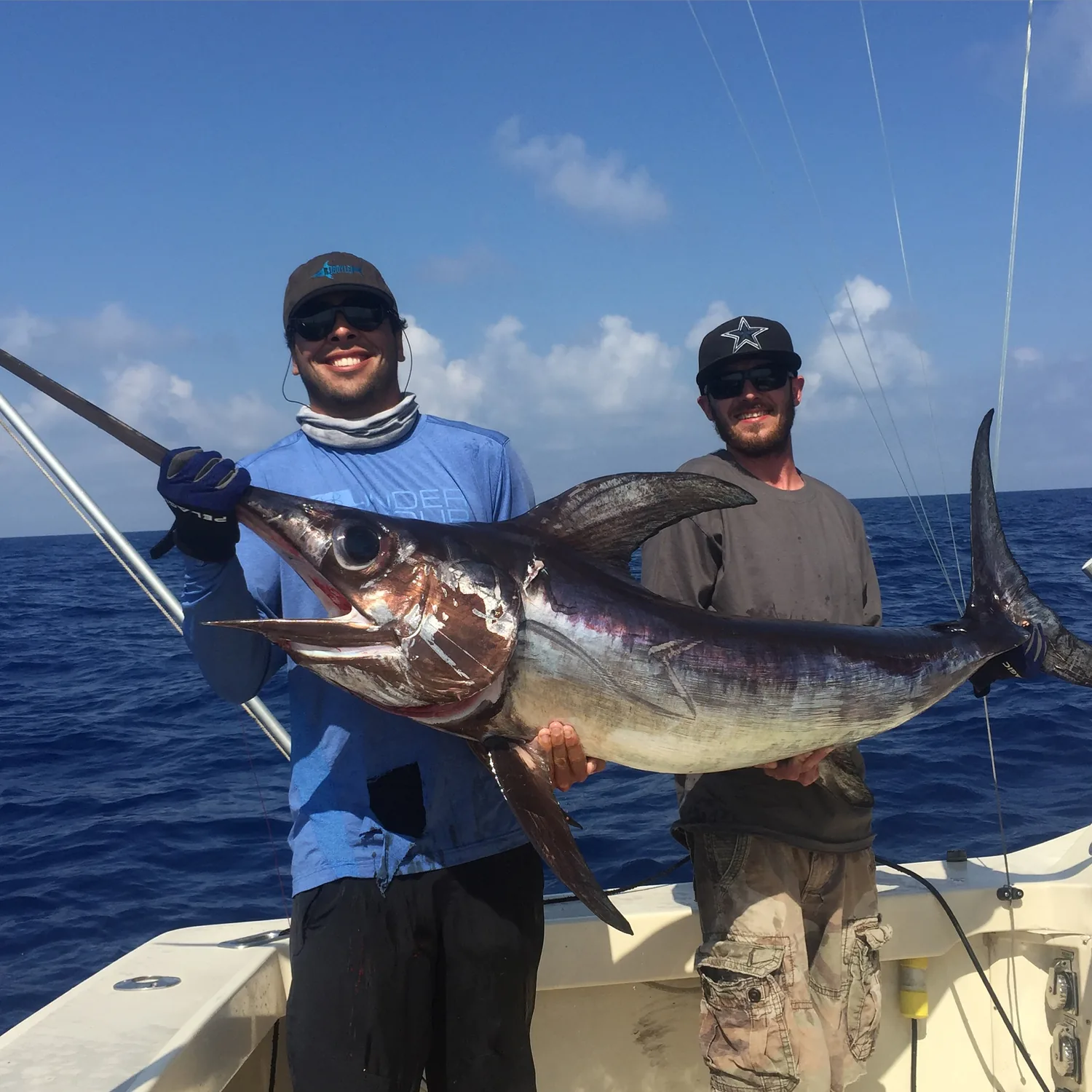
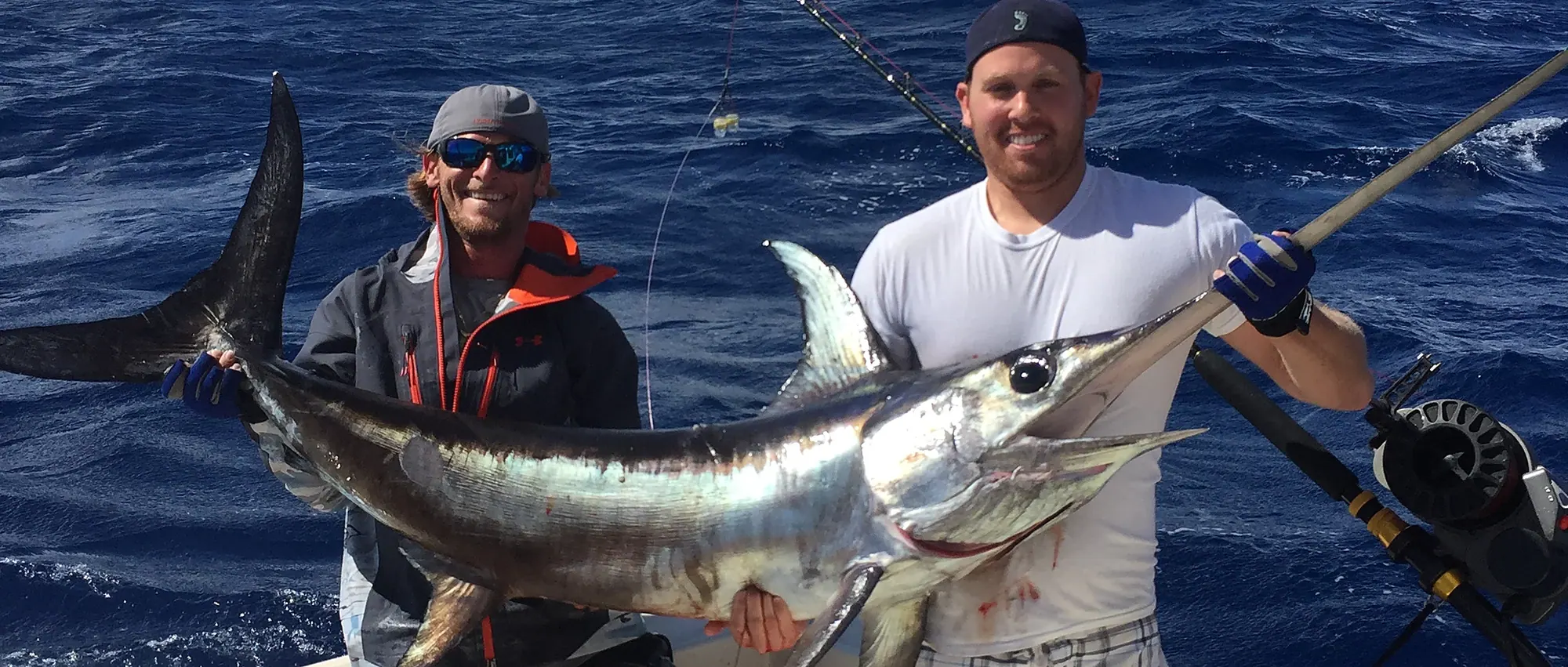
The broadbill swordfish is the gladiator of the deep, and it sits at the top of most serious anglers’ bucket lists for good reason. Atlantic stocks were nearly wiped out by commercial longlining in the 1970s, and tightened legislation on that gear let the population rebound, especially through the Florida Straits. The fish we chase off Miami today is the result of one of the better fisheries recovery stories on record.
Why South Florida
The Florida Straits is a recognized nursery for the entire Atlantic swordfish stock with juvenile fish commonly caught near the seamounts. Many of the adult swordfish swimming the eastern seaboard were born in this water. The Straits between Miami and Bimini run roughly 60 miles wide and the continental shelf sits about 12 to 15 miles off Miami creating a relatively narrow corridor where these fish concentrate. That funnel is exactly why commercial longliners hammered this stretch for decades, and a big reason the Straits remain productive now that the longlines are gone. Off Miami we catch year-round resident fish and the bigger migratory swordfish moving through as well.
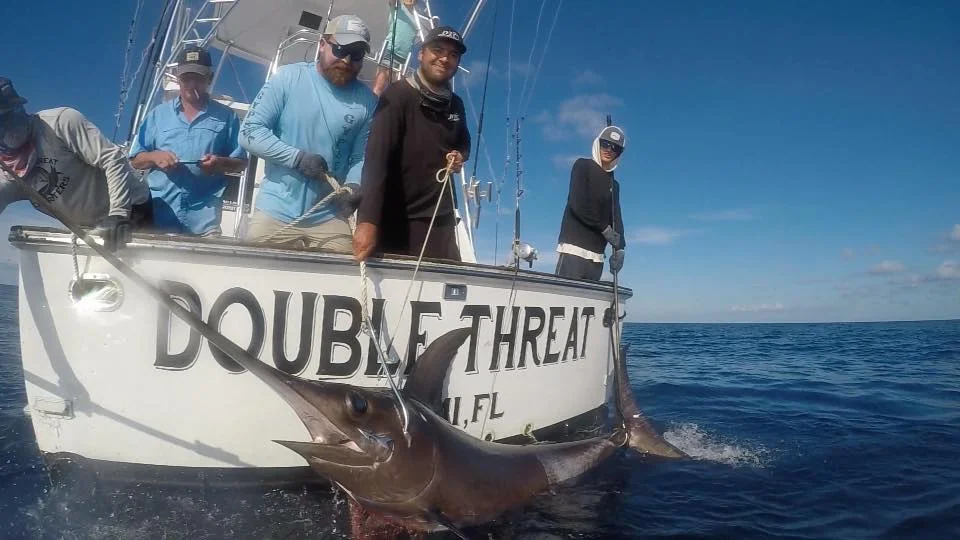
The actual structure we fish for swords is not unique to Miami. The same continental-shelf, canyon, and seamount geography runs from the Keys and up the eastern seaboard. If you find seamounts or canyons in the 1200-1800 range anywhere along the eastern seaboard there may be a swordfish to be caught at some point throughout the season. Swordfish prefer dark, deep water and vertically migrate toward the surface at night and back toward the bottom during the day. These are versatile fish that occasionally wander much shallower and are sometimes seen sunning on the surface during the day. We target them where they live and feed most, which is the continental shelf in 1200-1800 feet of water.
Daytime Swordfishing Charters Miami
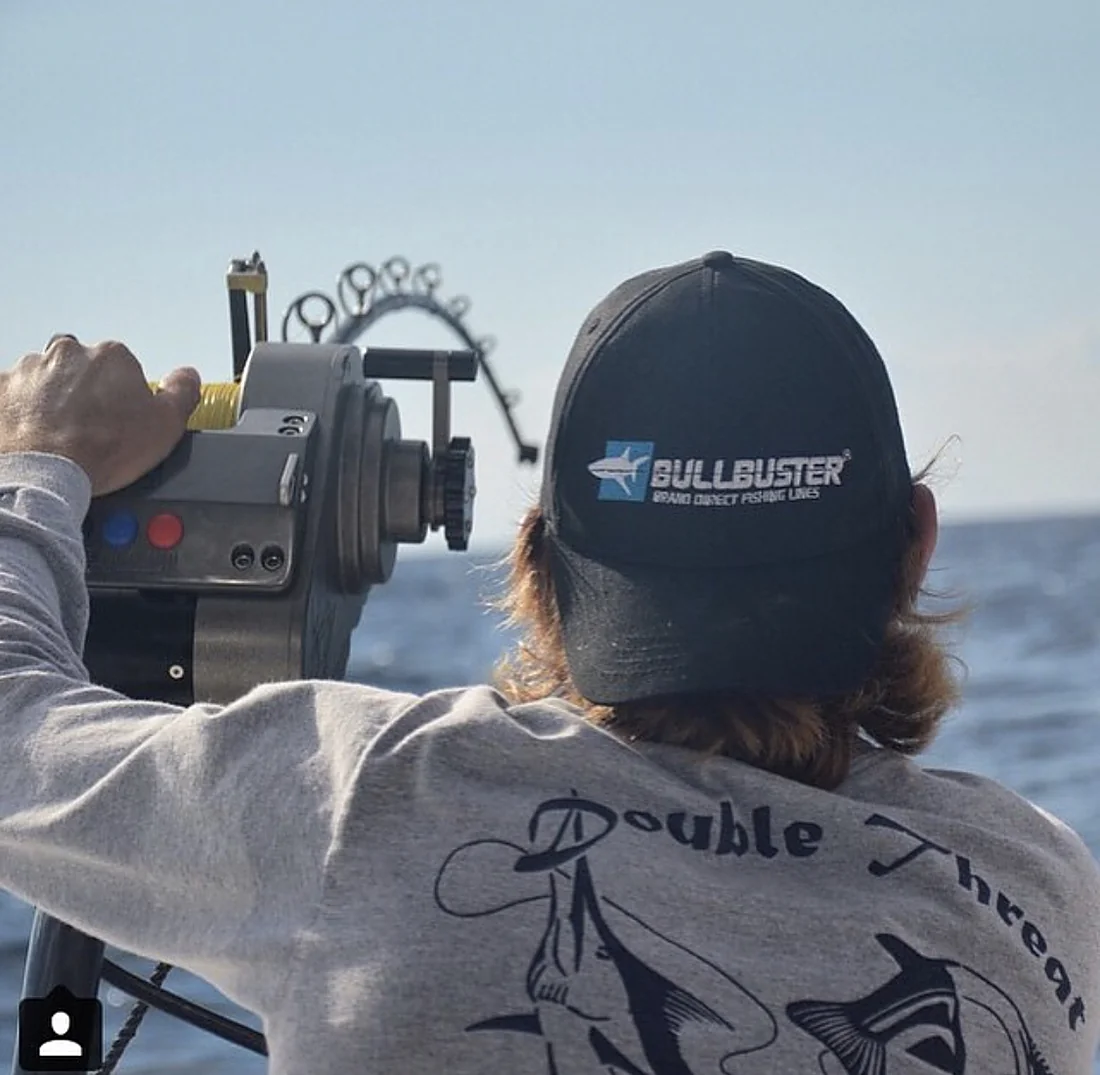
Daytime swordfishing is no longer a new technique. The method was pioneered in Venezuela, refined in the Florida Keys in the early 2000s, and has since spread through the Eastern Seaboard, the Gulf of Mexico, Europe, the Caribbean, and New Zealand. We caught our first daytime sword in 2012 which was relatively early in the broader adoption curve. The technique has continued to become even more mainstream since. Once we became comfortable catching swords during the day, we moved off of the old nighttime technique (which we still remember with nostalgia) and opted for the convenience and effectiveness of fishing during the day.
We run daytime trips because they are more productive and more comfortable. The fishing is easier to access, there is less wear on passengers, and the improved visibility gives you better odds during the end game on big fish. We have done the math over many trips, and we get more swordfish bites per hour of fishing during daylight hours than we ever did at night. We suspect the increased yield is related to the fish concentrating near the bottom on structure rather than spreading out at night. We will be straight about what this trip is. Swordfishing is the most expensive trip we run and it is a low-yield proposition by design. You can stare at a rod tip for hours and never get a bite, and then pull an alien up from half a mile down. It rewards patience and preparation more than almost any fishing we do. It is not a good first trip, and it is not for the angler who wants steady action. It is for the angler who wants to hunt the fish of a lifetime and understands that the hunt is the point. There is also more opportunity for bycatch on the run out and back, since schools of dolphin or smaller tuna are always a possibility.
Swordfish Migrations
Broadbill swordfish are a highly migratory species that range across tropical regions and push into temperate climates. In the Atlantic they swim from as far south as Venezuela to as far north as Nova Scotia. That latitude range is impressive on its own, but their daily vertical migration is the more remarkable trip.
Diel Vertical Migration (DVM)
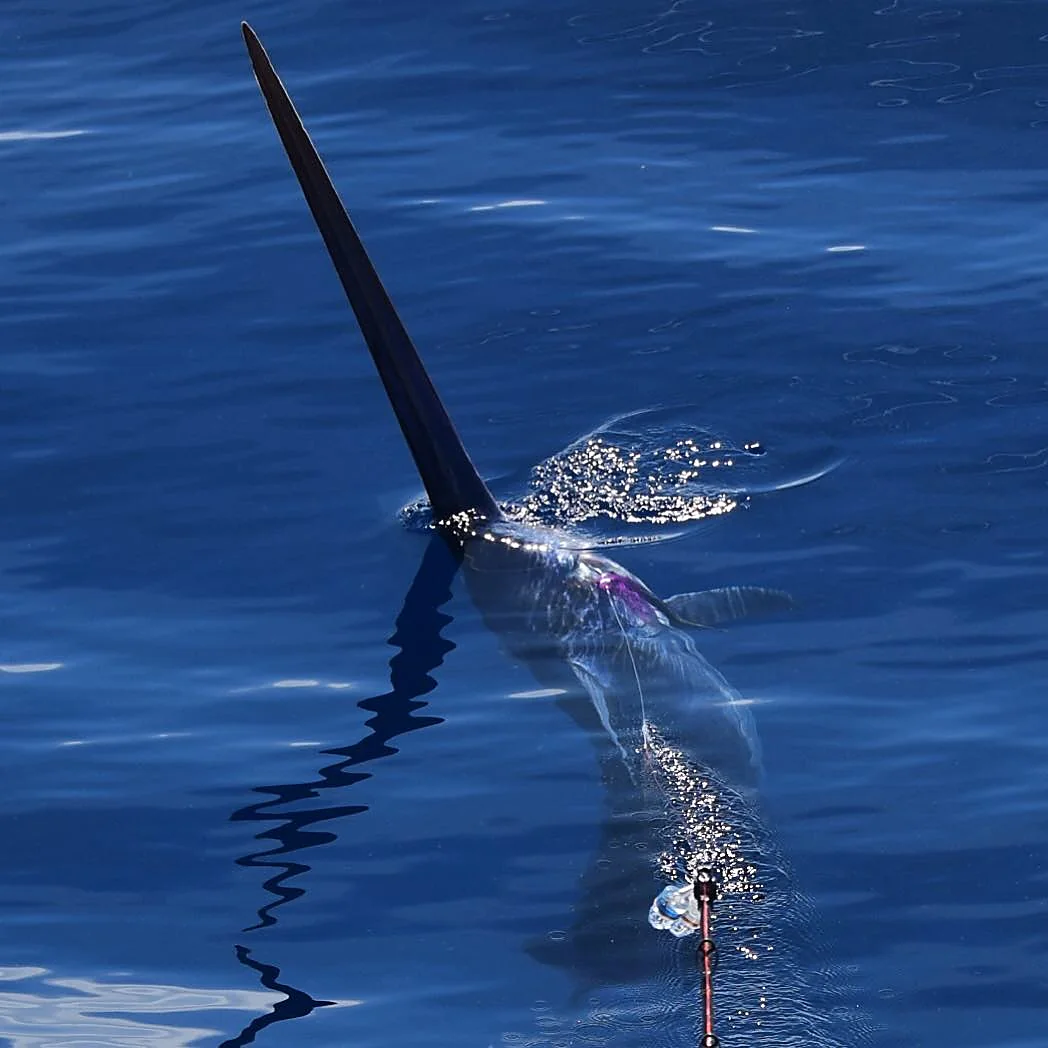
Diel vertical migration is one of the greatest migrations in the world when you account for the sheer volume of biomass that moves every day. Trillions of bait organisms in the form of krill, shrimp, and squid spend most of their time in the dark. At night they rise toward the surface, and during the day they sink back toward the bottom, almost always deeper than 600 feet where light barely penetrates. Swordfish follow that food through the midnight zone, the twilight zone, and occasionally the sunlight zone where they bask on the surface.
Their anatomy is what makes this possible. A swordfish has an endothermic heating organ near its eyes and brain that keeps both warm in water as cold as 40 degrees, which sharpens its vision in the cold dark depths and lets it hunt where its prey cannot see it coming. Just as impressive is the way the fish can rise quickly toward the surface without suffering the effects of the pressure change like you see with deep water snapper and grouper. Between the range of latitude and depth these fish inhabit, they are one of the most versatile predators in the ocean.
Daytime Swordfishing Technique
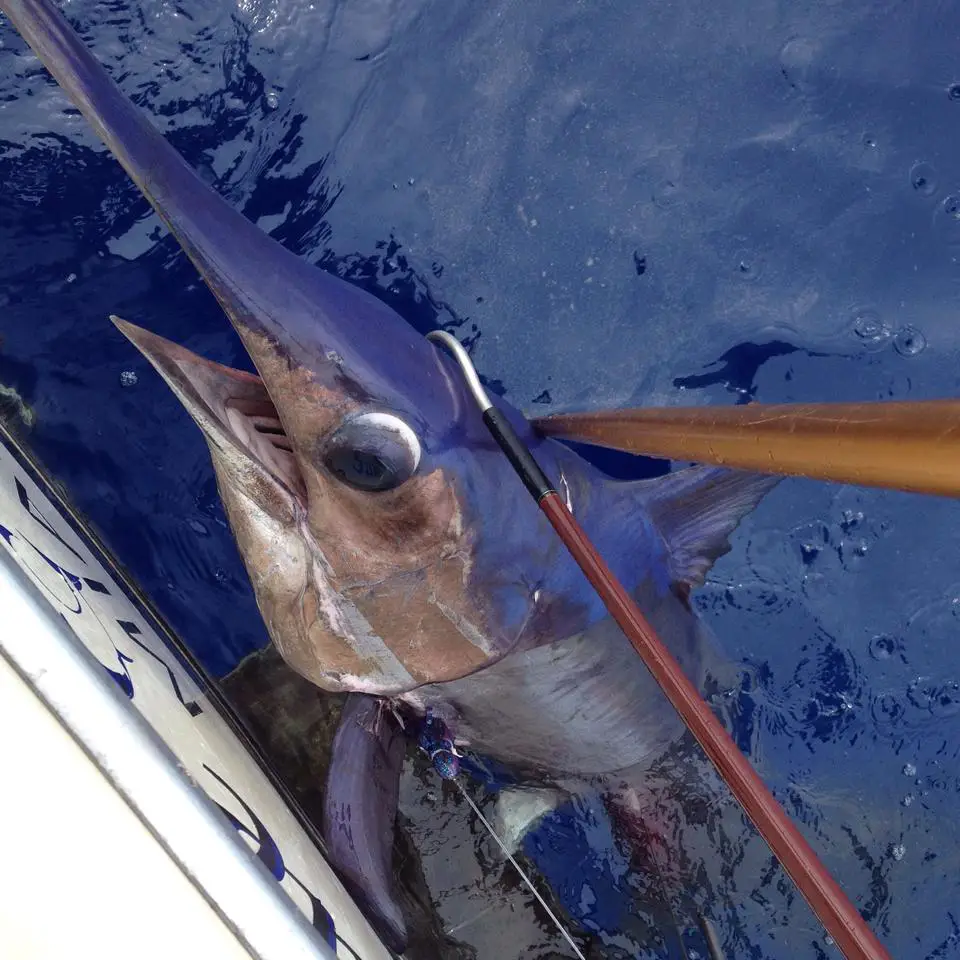
Fishing for swordfish during the day is rigging-intensive work. The entire approach involves sending a single bait on a long leader down to the strike zone and enticing a fish that lives near the bottom in 1,500 to 1,800 feet of water. You then have to see a bite on the rod tip with nearly half a mile of line out.
For swording we use electric reels (LP or Hooker Electric) on an 80lb class conventional rod with a bent butt and a soft tip. The reels are spooled with 65 to 80 pound braid. The thin diameter of braid is what lets the line cut through the current and transmit the bite to the rod tip. Without braided line, daytime swording off Miami would be nearly impossible and the technique would be consolidated to areas with little to no current. The braid connects to a 150-foot wind-on leader, usually with 250 pound mono, that connects to a ball bearing swivel and our 6 foot, 300 lb leader with the bait at the end. The final 6 foot leader is relatively short and allows us to bring the fish close enough to harpoon without the need to manually leader the fish. We usually fish a 10/0 J-hook but you can use 9/0 to 11/0 depending on the bait size. Our choice of a J-hook over a circle is deliberate. A swordfish usually slashes and whacks a bait several times before it eats, and at this depth and distance a circle hook is usually less reliable.
For weight, we run an inline stick lead attached to a floss mark nearly 150 feet away from the bait. This distance helps for tangles and also lets the long leader work as a shock absorber so the fish has a buffer between its mouth and the lead. The weights are heavy; we usually fish 10 pounds on average off Miami. Off the Keys or in the Gulf and areas with less current, 6-8 lbs is usually plenty. We add a couple of lights to every rig, a softer white light about 30 feet up from the bait as a broad attractor, and a more intense blue or green light 10 to 15 feet from the bait to draw the fish in close. For a spread, we fish just 2 rods rigged almost the same way. The tip rod fishes deep, usually within 300 feet of the bottom. The buoy rod rides higher and farther behind the boat usually 300-600 feet off the bottom. We get three to four times more bites on the deep tip rod, though the buoy rod fish tend to run a bit bigger when they come.
Once the gear is set, the technique is a controlled drift. We drive with the current while the bait goes down, then turn back on top of it and bump the boat into the current with the bow facing the flow. By bumping into the current, we are able to cut our speed from about 3-4 knots to 1.5-2 knots over ground which is fast enough to cover water but not too fast to remain thorough. We work the tip rod actively, dropping to the bottom and reeling up a couple hundred feet, then dropping again, because many bites come right after the bait moves. Swordfish are aggressive and love seeing a bait suddenly flashing or darting through the water column.
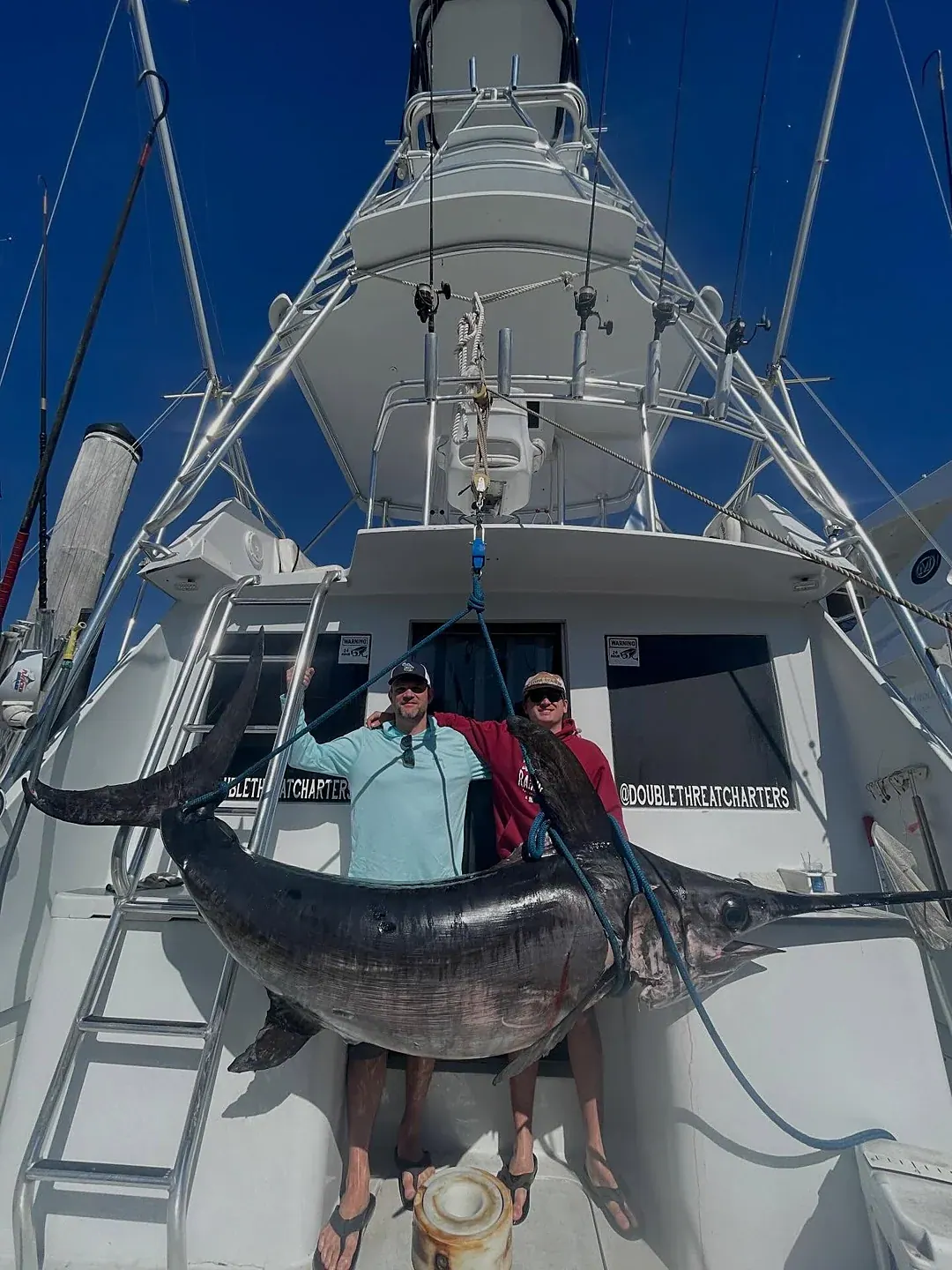
The bite itself is tricky to observe and takes practice to know what you are looking for. With around 2,500 feet of line out, fishing almost half a mile from the boat, a swordfish bite reads as nothing more than a nibble in the rod tip. You may be watching the rod tip rise and fall with the boat’s rhythm, and a bite may just look like a brief interruption in that rhythm. Calmer days are easier because the baseline is steady. Rough days make it harder to fish and harder to see the bite. Typically, when we do see a bite, we like to pull the bait away from the fish first which usually makes them mad. After they attack the bait a second time, we like to drop back and let them eat. The drop briefly creates slack in the leader which can be enough for the fish to grab the bait in its mouth. Sometimes the sword will attack the bait 4-5 times before you hook up. Sometimes they whack it once and swim away.
For bait, there is no single best choice for daytime fishing. What matters is that the bait is tough enough to survive several bill slashes before the eat and the bait needs to swim well at three or four knots through current because you do get bites dropping and raising the bait quickly through the water column. Foldovers are our best overall daytime bait, usually a filet of bonito or kingfish stripped down mostly to skin, folded into a taco shape, and stitched up so it is wiggly, soft, and tough at the same time. Belly strips, snakehead bellies, squid, and even American eels can all produce. We run a skirt over almost every bait to make it more hydrodynamic and add durability, and we stitch the bait so the pull point sits at the very front, because a bait that pulls from anywhere else spins instead of swims.
The Fight, the Harpoon, and Preparation
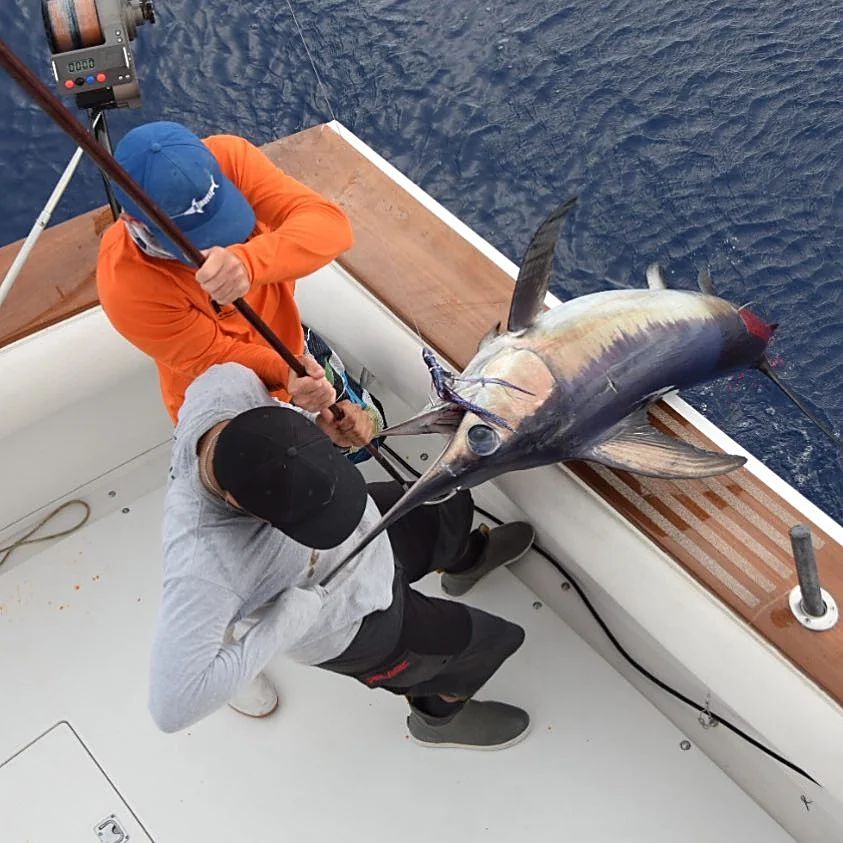
Most of a swordfish fight is simply pulling a 10-pound lead up from a few thousand feet away. With the lead, there is heavy pressure on the rod before the fish even does anything, so drag management matters from the start. Smaller fish come up fairly passively until they hit the wake-up zone 200 to 400 feet from the surface, where they see the light change and start to push back. The big ones announce themselves differently. A fish over 200 pounds will often swim the lead straight up toward the surface, the line goes slack, and you take up that slack while backing down. When something is swimming a 10-pound lead to the top, you know you have a nice sized fish. After a long, uncertain retrieval, the best part in swordfishing is when you take the lead off and you see the leader is still tight.
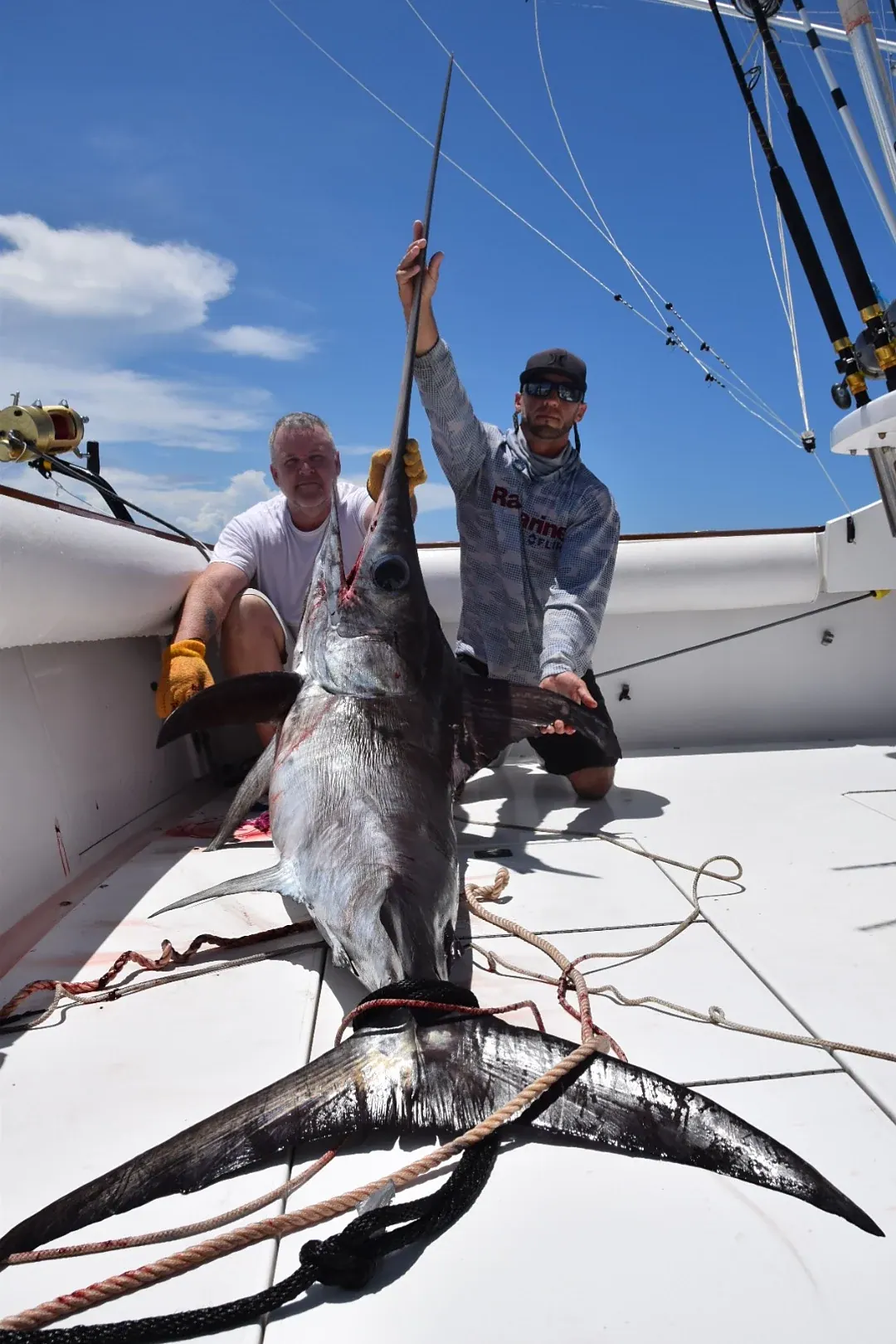
Swordfishing is best conveyed as a group hunting effort, not a one-angler stand-up deal. Our clients usually switch off on the reel, fight the fish out of the rod holder, and often help at the gaff. When the fish finally gets close, the harpoon is the most important tool on the boat. We carry 2 harpoons and try to throw the first one as soon as we possibly can if we know it is a legal fish. Swordfish sometimes come unglued right at the boat which will make you grateful you at least tried to throw the harpoon. Our rule is simple: it is better to throw the harpoon and miss than to not throw at all. Take the shot.
Swordfish are tough and this is a low yield fishery. Not only are bites hard to come by sometimes, swords have soft mouths, soft skin, and they are sloppy eaters. Hooks can pull and harpoons often rip free which is why we carry 2 on board and always throw when we can. During 2021 we hooked a big fish that slacked us and swam the lead straight to the surface. Kris took a deep shot with the harpoon as soon as he saw the fish which was under 15 minutes into the fight. The fish didn’t even know it was hooked and now it was dumping harpoon line. It took 500 feet of harpoon line before the hook pulled. Then it continued to swim to the bottom entirely disconnected from the reel. We only had the harpoon dart in the fish, no hook, and we weren’t sure where we hit it. We connected the harpoon line to a 130-pound class rod because it took 1,000 feet of rope and kept going. It swam all the way to the bottom where we played tug of war for about 2 hours before we got our harpoon line back and continued to fight the fish for another two hours, by hand. Nearly 5 hours after the initial hook up a second harpoon went in the fish. This fish weighed 456 pounds at the dock.
Nighttime Swordfishing Miami
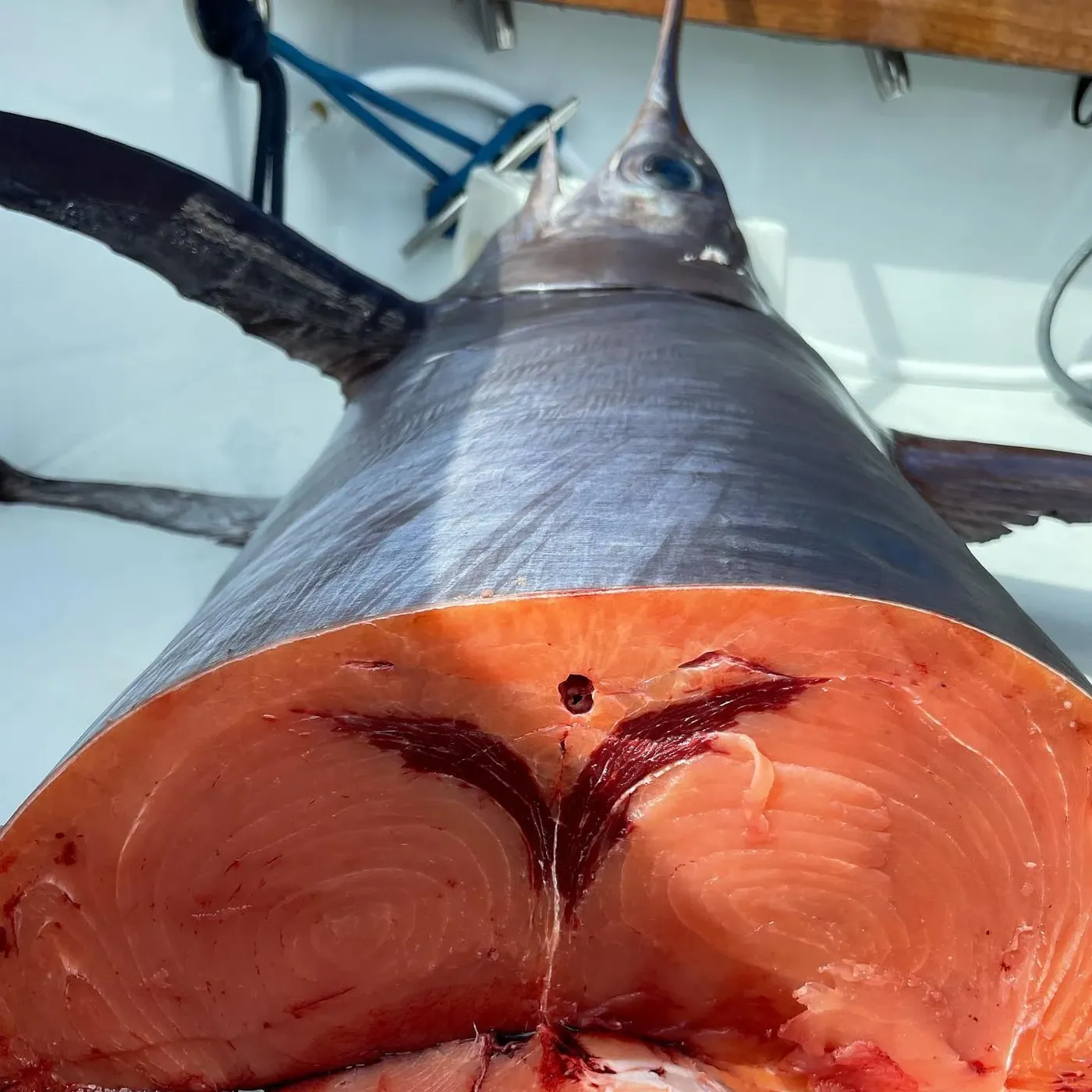
We no longer run nighttime swordfish trips for charters but we do think about the good ol’ days. The daytime bite is more productive and more comfortable, and buoy-gear pressure slowed the night fishery considerably after 2010.
Nighttime swordfishing is very different from daytiming. At night the fish rise toward the surface to feed, so you are not fishing nearly as deep. We would drift the humps at night targeting the upwellings above the seamounts in the 1,000-1,200 foot range which is a bit shallower than the area we fish during the day. The spread was usually four rods on buoys, with natural squid set at 50, 100, 200, and 300 feet down. We would usually throw in a tip rod as well that we would work up and down through the column. Natural squid is the best night bait and the right choice on the tip rod, but live bait can work well, especially on the buoy rods. For live baits, lean toward something big and lively like a large blue runner, speedo, or rainbow runner. For nighttime fishing we would usually use one light rather than two and 1-2lbs of lead rather than 10. This was a mini version of the daytime rig with a more delicate bait that was basically just fished shallower and higher in the water column at night.
For night fishing, we used to fish lighter gear often opting for 50-wides, and the fights were genuinely fun, especially on fish in the 80-150 pound range. 80 lb tackle would have normally felt like overkill but we were taught a pretty serious lesson a long time ago on the Blue Yonder. We had one trip in particular where we ran a combo trip (sword fishing during the day before transitioning to night fishing). Around midnight, as we were about to wrap up after a long day, we saw one of the lights suddenly racing in the wrong direction across the surface. We came tight and knew quickly it was a good fish but we weren’t sure how big because it wouldn’t take off on a crazy run. The fish just wanted to hang out within about 150 yards of the boat, and every time we got it close it would freak out, run, and jump or do headshakes. We fought the fish for over five hours until daybreak, and by then we were applying far more drag than we should have, because we simply had not planned on fishing for twenty hours, someone had a flight to catch, and we were getting very far from Miami. There is so much current off Miami that a five-hour fight drifted us another twenty miles, and we were already about thirty miles north of where we started. We were getting low on fuel by this point and pushing the fish harder than we wanted to. Just before sunrise, the line broke. We never got a clean harpoon shot, because the fish kept jumping and it was pitch black that night with no moon. By the time we fueled up at Hillsboro and ran home, it was a twenty-four hour trip with nothing to show for it. That fish was every bit of 500 pounds, and losing it still stings.
If you go swordfishing, always be prepared for a five-hour fight at any time. If you plan to fish until one in the morning, you need to be mentally ready to be back at the dock at six if you hook a fish late, because sleep deprivation changes the whole dynamic. The same rule applies in the day, where fishing until five in the afternoon can mean getting home at ten at night. The fish deserve respect, time, and preparation.
Swordfish Size, Bycatch, and Conditions
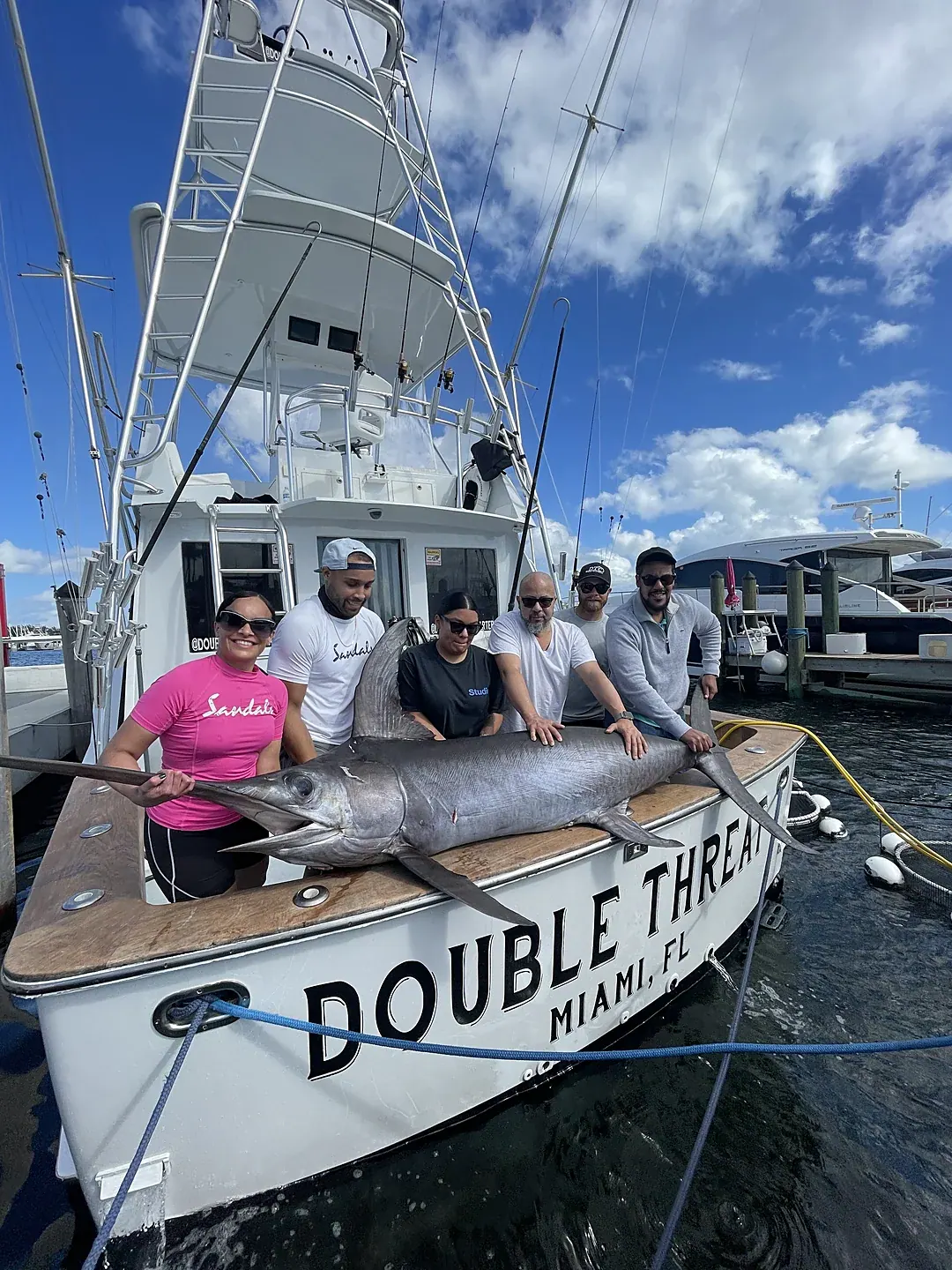
Daytime swordfish off Miami average around 120 pounds, with fish to 300 pounds not uncommon. We have caught a lot of fish over 300, and 500-plus pounders are a real possibility on any drop. The 500-pounders eat the same baits as the smaller fish, so you never really know what is on the line until you are well into the fight. Night fish average a bit smaller, in the 80-pound class, though the big ones are always out there. The species reaches around 14 to 15 feet and over 1,400 pounds, and while commercial and recreational pressure makes a true giant hard to find, the genetics for one are still in the water.
There is not much bycatch in 2,000 feet, but a few other deep-water species show up. We have caught bigeye thresher sharks, squid, and the occasional pomfret or escolar while swordfishing. Bluefin and bigeye tuna are randomly caught on the sword grounds as well. If you think you have a big sword on a daytime drop but it does not swim the lead up toward the surface, there is a decent chance it is a bigeye thresher or a big tuna instead.
As for season, this is a year-round fishery with a real window from October through May, and a workable one from September through June. Our favorite stretches are September through February, when there are more fish around, the average size is bigger, and there is less pressure from other boats but you do need well timed weather windows during winter. We find that July and August are the slowest months for swords off Miami.
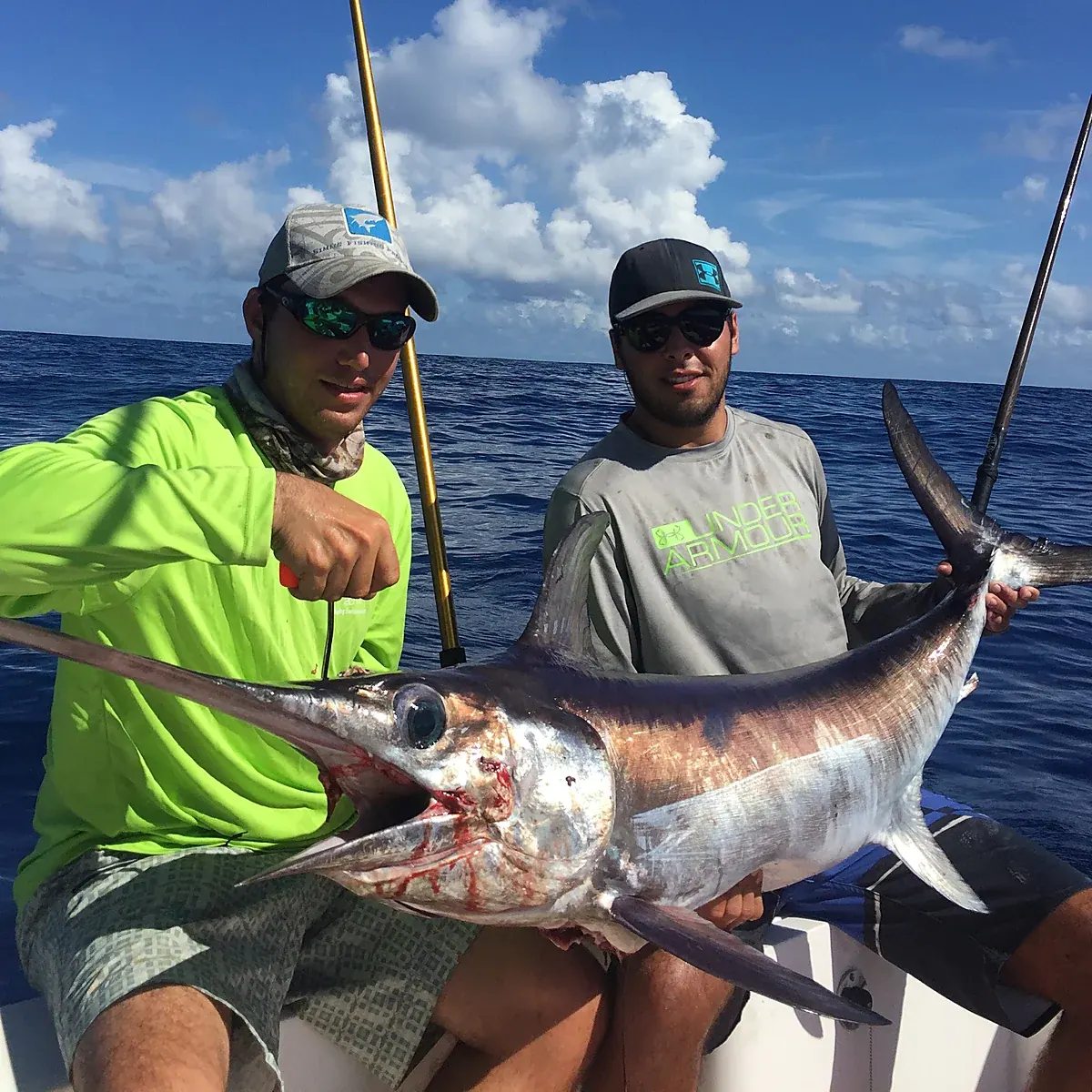
We will be honest about the odds of catching a sword because the fishery deserves well managed expectations. The general rule is about one fish in the boat per 10 hours of dedicated fishing, and we land a sword on roughly 60 percent of the trips where we commit to it. You can go out and not have a bite all day. You can also have a day where you put four fish in the boat out of six bites. Instagram makes the catch rate look higher than it is, with many anglers posting their best moments rather than the slow drops and the lost fish. The truth is that you will not catch a swordfish without putting in the time and it is best not to get discouraged. There is no shortcut, and the patience is the price of admission if swords are on your bucket list.
Swordfish is excellent on the table, with a lot of meat per fish and the fillets freeze well and share easily. Swordfish does carry a high mercury content, which the FDA flags specifically, so it is not a good fish for pregnant women and is less than ideal for frequent consumption.
If you want to put in the time and hunt one of these fish with us, book a daytime swordfish charter with us and we’ll see if we can help you get tight.