
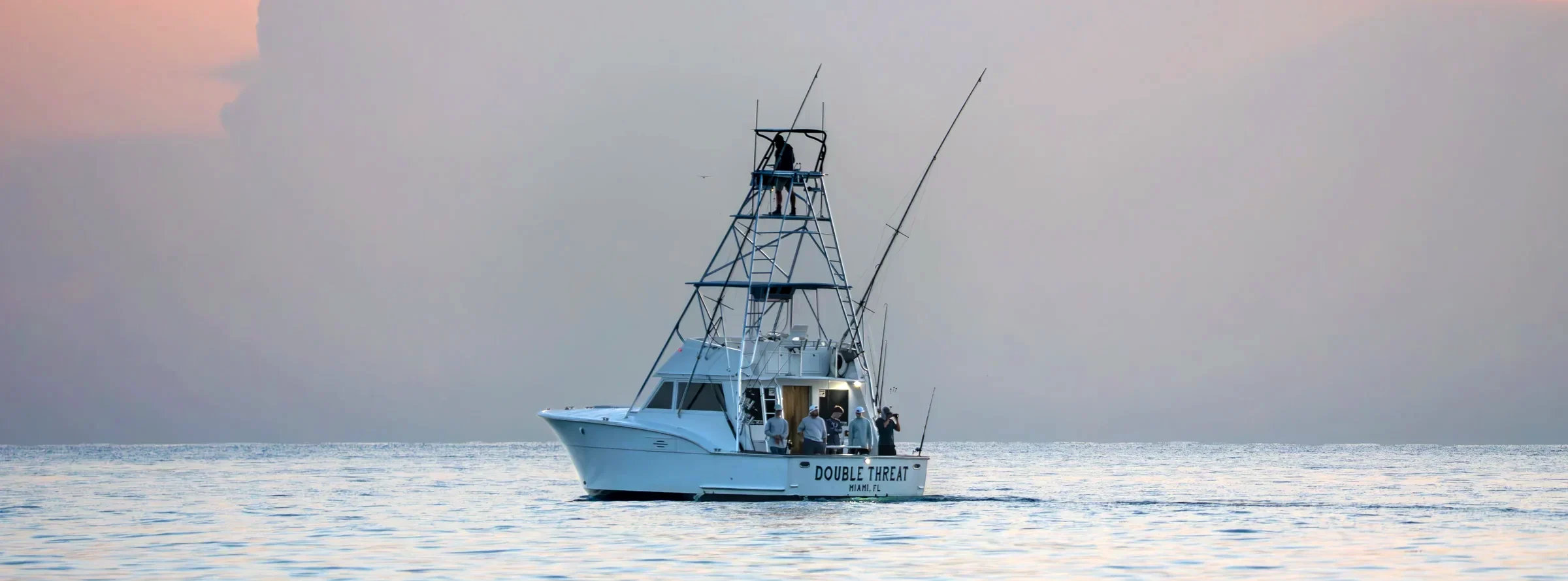
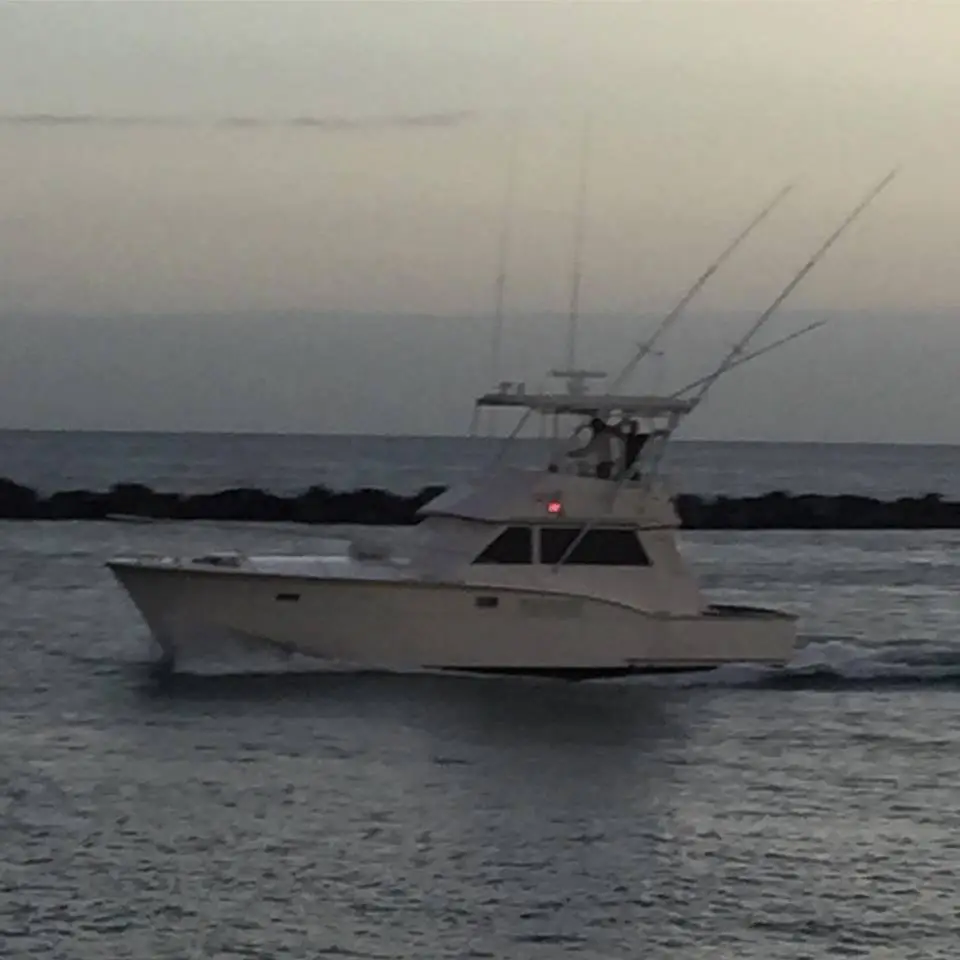
The Double Threat is a 1972 Hatteras 42 Convertible. She measures 42 feet 11 inches, so we call her a 43. The boat is from the early 70s but she has been extensively retrofitted inside and out. This page opens with a brief overview with some specs and pictures of the rig. If you want the full story of how she got here, you can read our story further down the page.
See the boat ↓ · Read our story ↓
The Hull — 1972 Hatteras
Hatteras built the 42 Convertible in an era when engineers overbuilt hulls to be safe, before cored hulls became the norm for cutting weight and cost. The result is a thick, solid, fiberglass hull with classic lines that runs well and stays dry in a sea. A hull built like this can last virtually forever, which is one of the main reasons we started with a 1972 Hatteras instead of buying something newer.
The Power — Cummins 450C “Diamond Series”
The Double Threat is equipped with twin Cummins 450C “Diamond Series” diesels, a repower from the original Detroit diesels these boats came with. The 450C is a sleeved, inline six-cylinder motor that can be rebuilt in frame, which makes it durable, economical, and easy to service. These are some of the best diesel engines ever built. We have fifteen thousand hours on the starboard motor and it is still running great as of July 2026.
Exterior
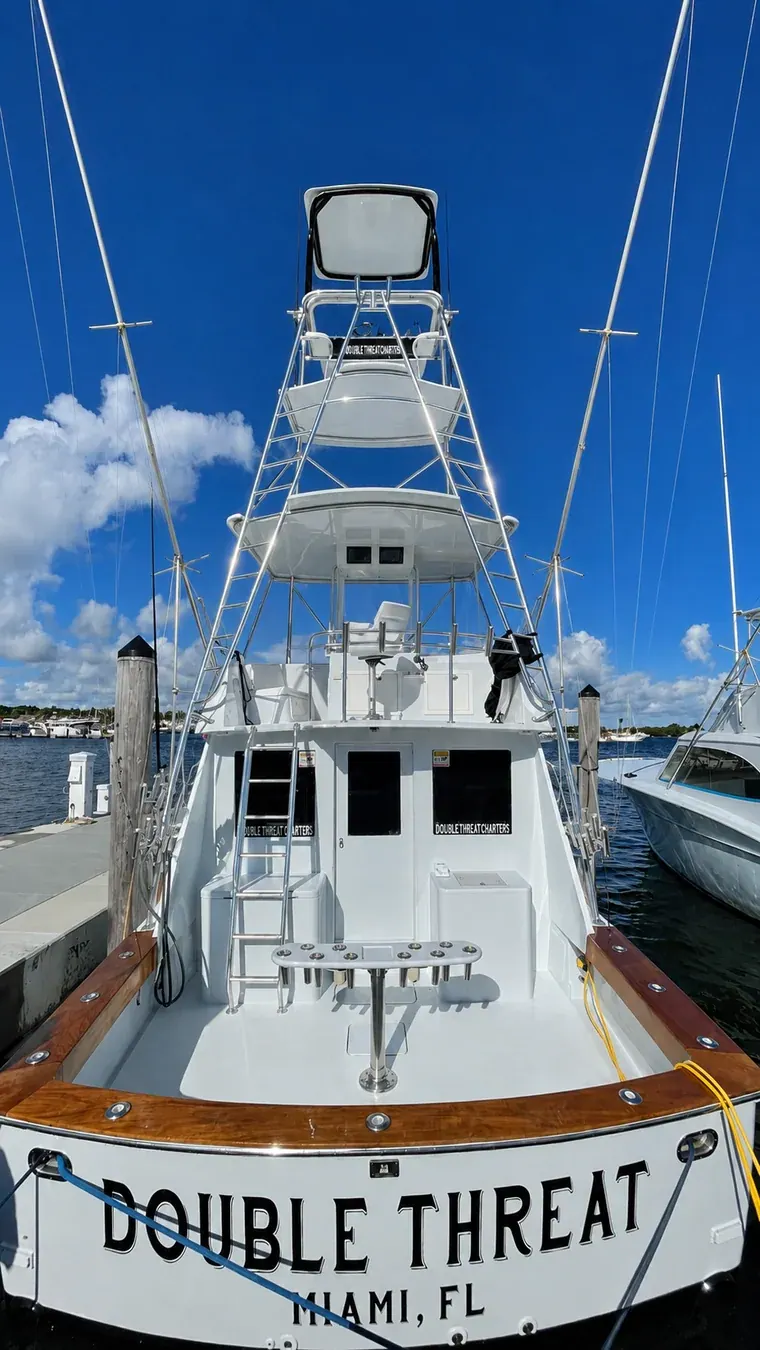
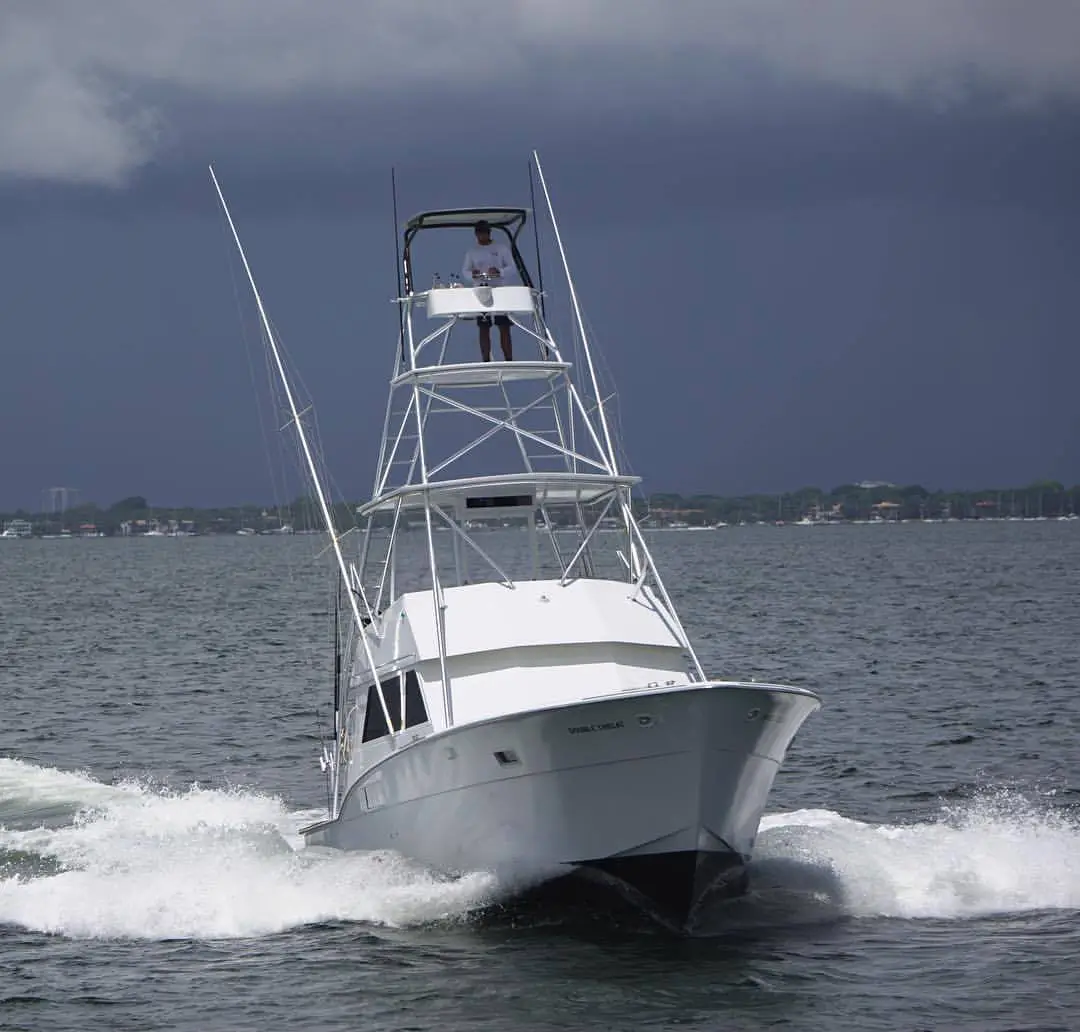
The boat is tournament rigged with triple spreader outriggers and has a full tuna tower to give the captain an elevated vantage point to look for fish. We have a custom fish box, livewell, leaning post, and modern electronics to ensure that the crew has everything they need to work efficiently. We paint the boat every 4-5 years and take pride in making sure the Double Threat always shows well.
Interior
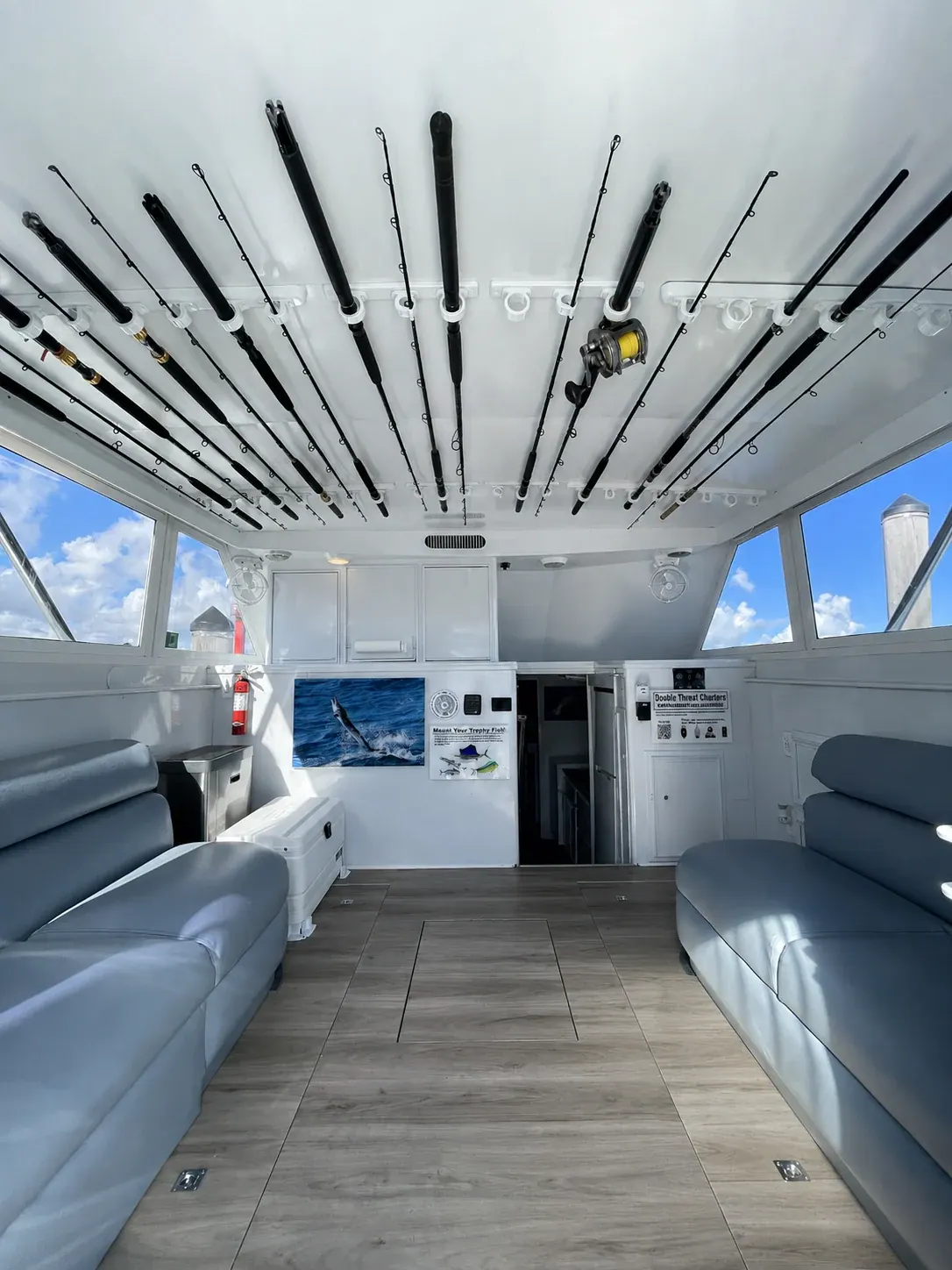
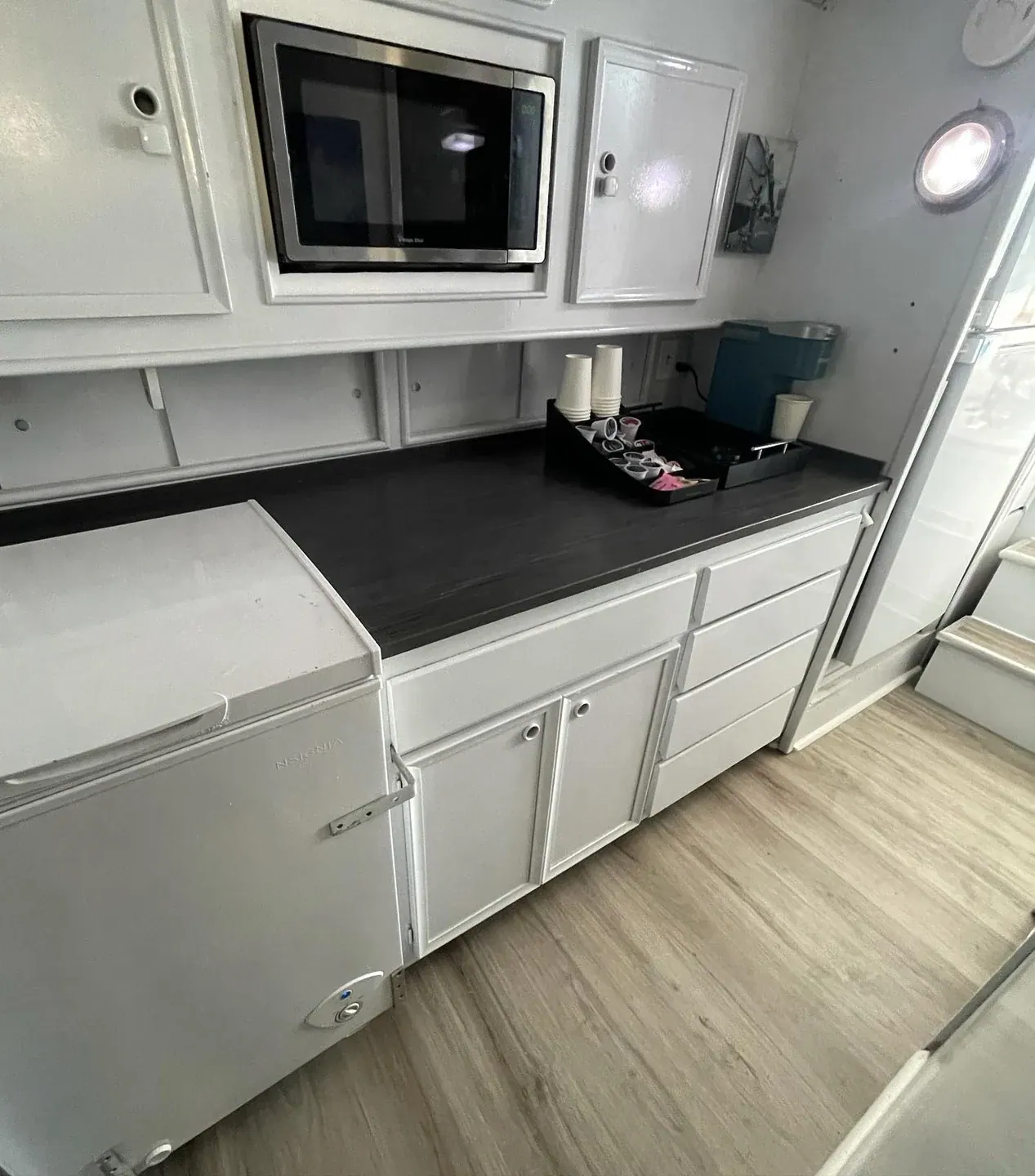
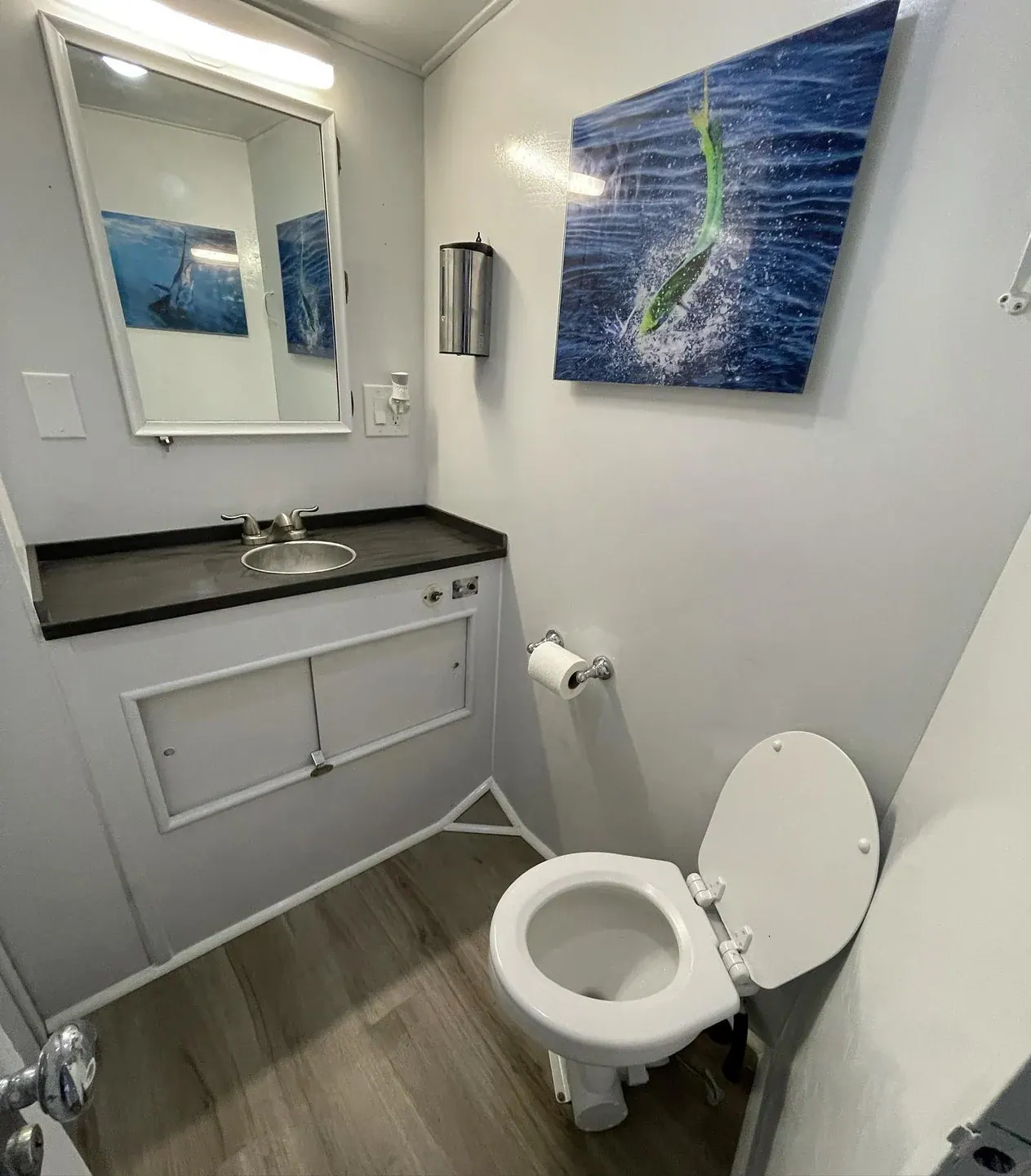
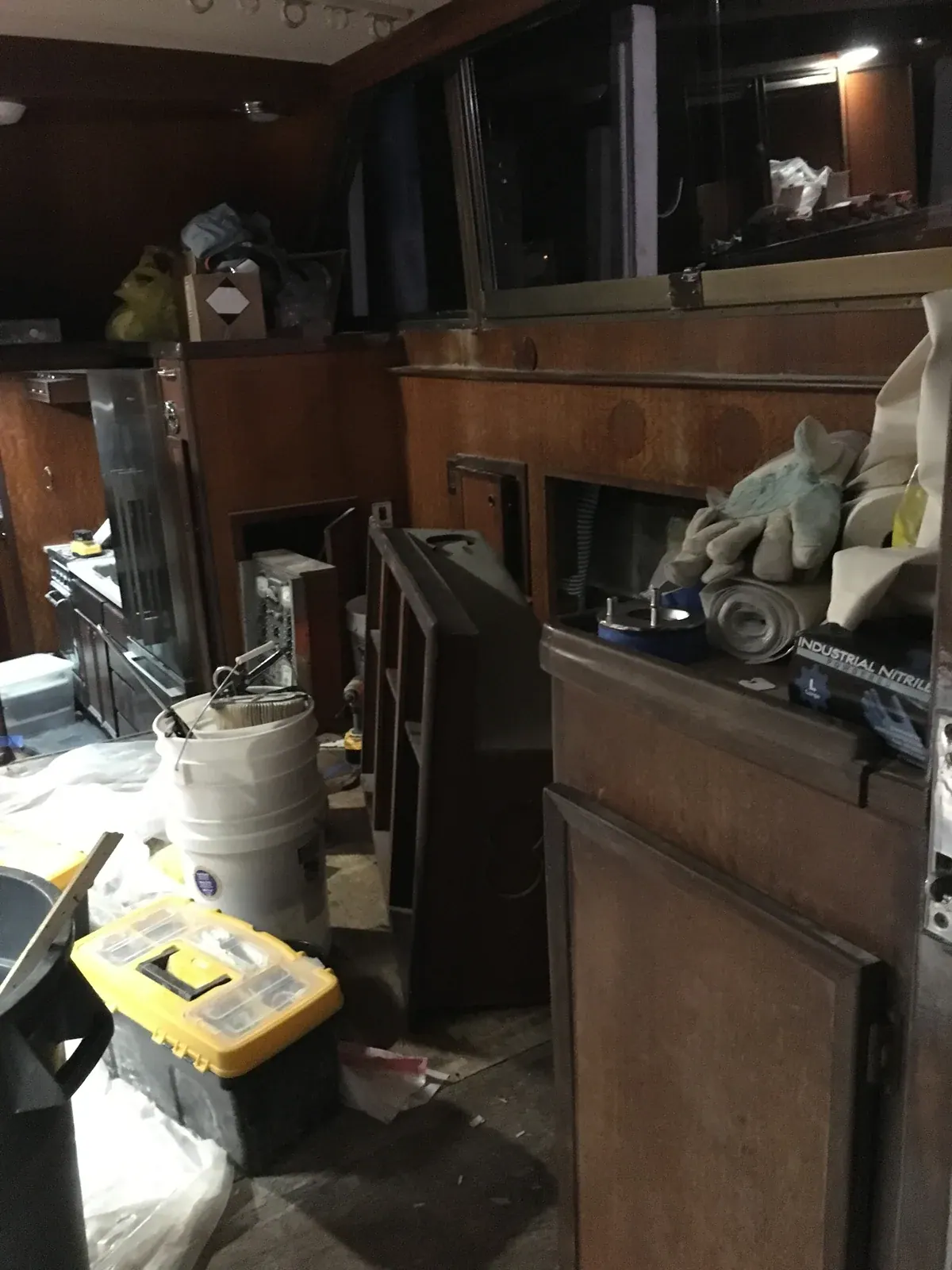
Step inside and you’ll be greeted by our two air conditioning units that are powered by an 8 kW generator. The salon does not look like a boat from the 70s. We extensively refurbished the interior in 2021 and installed new flooring, windows, countertops, and completely painted the interior. The inside is clean, bright, and comfortable for a long day on the water. The interior has seating for up to 6, a refrigerator, galley, and a head (a bathroom) aboard, which matters more than people expect on a full day offshore.
Flybridge
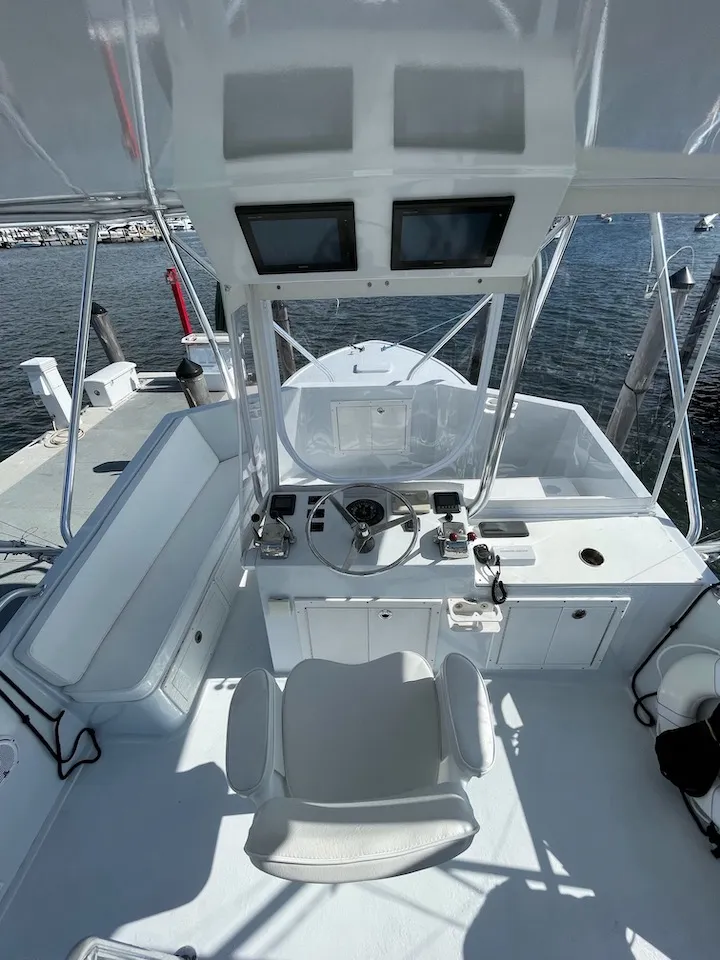
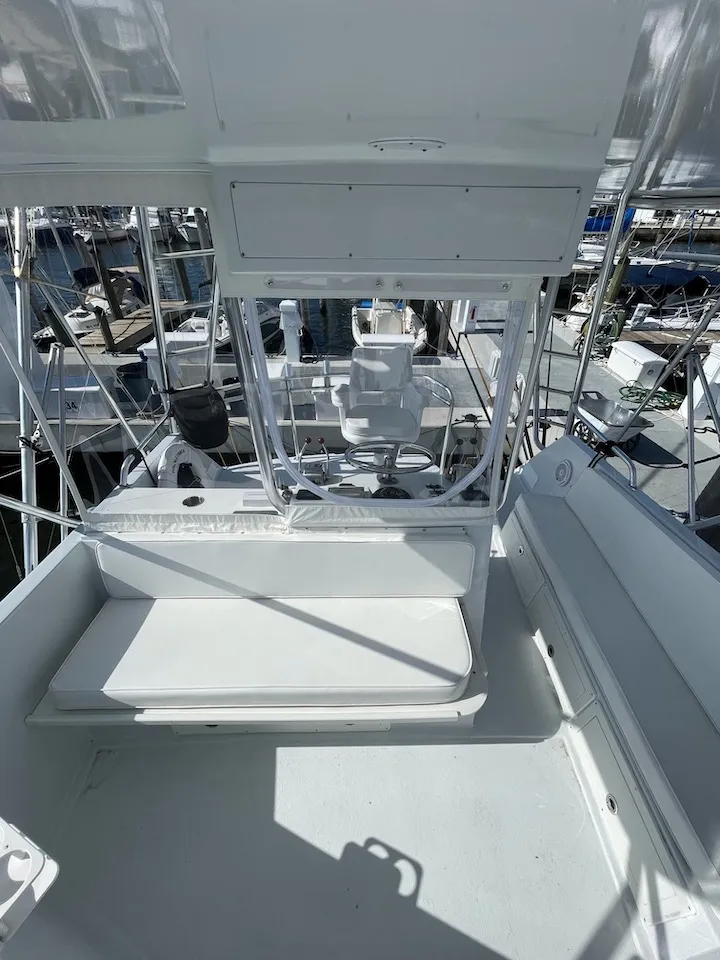
The flybridge seats up to six, with a hardtop for shade, and a full electronics suite to help the crew find fish.
The Rebuild Story
I bought the Double Threat in 2016, when I was just 23 years old. I had saved up some money and felt that we needed a custom platform as a long-term investment for the business. This is how a 1972 hull I found a thousand miles from home became the boat we run today.
The boat I wanted wasn’t for sale
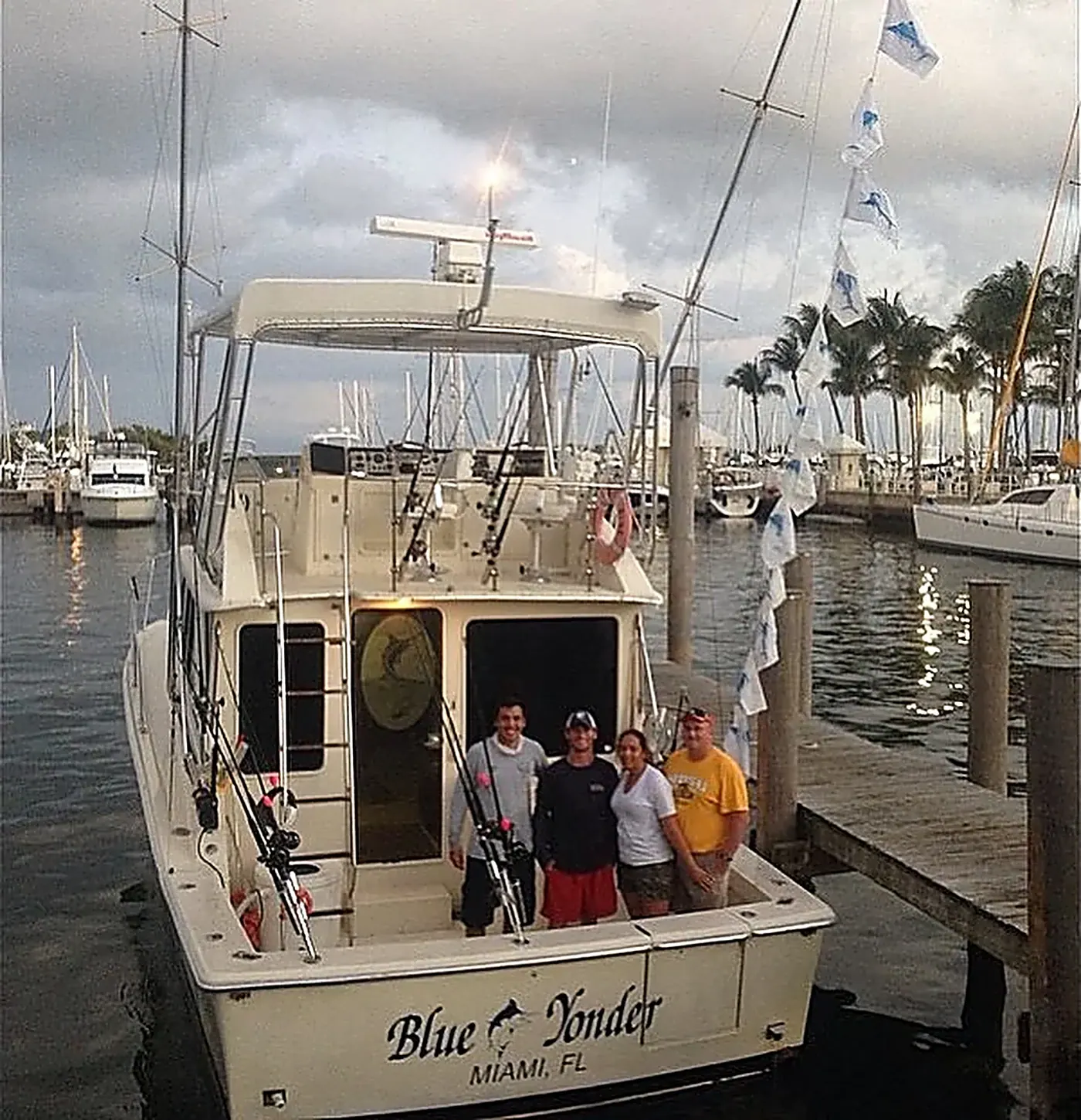
When Double Threat Charters started, I ran a 38-foot Chris Craft called the Blue Yonder, a convertible sportfish with Caterpillar 3208s. She was a workhorse and she paid the bills for about five years, but I always saw her as a stepping stone to the boat I actually wanted. The problem was that the boat I wanted was not for sale anywhere without dropping millions on a new rig (which obviously I didn’t have). I wanted a seaworthy hull, modern power, a full tower, and a tournament-rigged cockpit packaged in a vessel that was serviceable and economical. The only way I felt I could check all these boxes was to find an old boat and rebuild it for what we do. In 2016 I started looking around the country for the right one to rebuild.
Three boats and a walk-away
The first boat I looked at was in Florida. It was a 1978 42 Hatteras with newer Yanmar engines. It actually showed well, but I was more interested in Cummins motors, which had a better reputation in this horsepower range. Next I flew to Texas and looked at another 1978 42 Hatteras. This one had already been repowered with brand-new Cummins QSCs and a new generator. It had new electronics as well. You could see the owner had started a full refit and quit halfway. I estimated the seller had invested $250,000+ into the boat between the engines, the generator, and the electronics. I had it under contract at $125,000 and I still walked, because I could tell the rest of the boat needed so much work that the numbers would never make sense.
That Texas boat was a good example of how financially challenging these renovations can become. You can put $300,000 into a hull and end up with a boat worth $150,000 or less. These are not houses, and they do not hold their value while you pour money into them. The projects also have a tendency to increase in scope. The seller in Texas figured that out halfway through his build and stopped. I could have bought his renovations at 50 cents on the dollar and finished the job, but the boat still needed an enormous amount of work and I would never get my money back. It was hard to ignore how irrational a rebuild can turn out to be, but I needed the right platform for the business so I went ahead and did it anyway.
The one nobody wanted
The boat I ended up buying was a 1972 42 Hatteras located in Wildwood, New Jersey. It was listed at around $69,000 and named “Añejo,” or “Aged” in Spanish, which was fitting given the model year. This hull was already repowered with Cummins 450Cs, but it had almost nothing else done to it except for a set of beautiful teak gunnels a previous captain had built by hand. The boat had been on the market close to a year, which anyone who shops boats knows is a bad sign. It was the last Hatteras in this size range on the market that was already repowered from the original Detroit diesels, so I got it under contract and flew up to New Jersey to sea trial it. I had my dad come with me to help and give me his feedback.
The sea trial was a disaster. The engines had no hour meters. We found a fuel leak on the starboard fuel pump and a head gasket leak on the port motor. When we tried to accelerate she would not make RPM and could not get on plane. On the way back to the slip I went down to check the throttle connection on the port motor, and while I was leaning over the outboard side, the raw water hose inflated like a balloon and exploded, dumping on me like a fire hose. The engine was too loud for anyone to hear me yelling, so I crawled out, told them to shut it down, and stood there soaked with no change of clothes. We flew home that same day. I was on the plane, still damp, when I decided this was the boat I was going to buy.
The bet
Given how the sea trial went, it would have been reasonable to walk from this boat as well, but there was something about this one specifically that had me come back to New Jersey. The boat had the intangibles I liked, with an overbuilt hull and classic lines, and she was powered with 450Cs, which had a reputation for being best-in-class motors in this horsepower range. Aesthetically, the boat was in good shape and you could tell the previous owners took good care of her. But with the good came the uncertain: the engines had no hour meters and there were glaring mechanical issues already. On the hour meter issue, I did my best to back into the time rather than guessing. The survey from my seller’s own purchase showed about 250 hours. One of the chartplotters that my seller installed had its track history on it, never cleared, and from that I could see roughly five seasons of use, which averaged out to about a thousand additional hours. I figured about 1,250 hours on the engines, and the generator’s hour meter lined up with that, which was the one hour meter on the boat that actually worked. Ironically, the generator itself did not run, but it was the same Onan MDKD we already had on the Blue Yonder, and we knew exactly why it was dead and how to bring it back.
The math is what made some of this sane. A full repower on a hull like this runs close to $150,000 once you count motors, shafts, transmissions, prop work, and labor. The repower is expensive, but a 450C is a sleeved, inline six-cylinder motor with a reputation for being one of the easiest to rebuild when it does break. I knew I could rebuild both of these motors for $12,000 to $15,000 each. Worst case, I put $25,000 to $30,000 into the motors, reset the clock on meters that never existed, and I would have around $85,000 in a boat with engines good for 10,000 hours. The economics gave me a floor to work on the highest-ticket items.
I hoped for the best and budgeted for the worst.
That said, this boat was more than just a pair of motors. I was 23 at the time, I had $130,000 for the entire project including the hull purchase, and everyone who knew me thought I was crazy. They were right. I did not know what I was getting into, and the project quickly expanded in scope.
Getting her home
Buying the boat was its own ordeal. The seller was difficult enough that I ended up coordinating repairs myself on a boat I did not even own yet. I found a mechanic up in New Jersey to rebuild the fuel pump and replace the raw water hose, and I left the port head gasket for my own mechanic in Miami because I kept getting gouged up there. Then the title search turned up an old lien, satisfied years earlier but never cleared from the record, against a bank that had since gone out of business. We went under contract in July and could not close until September.
By the time we owned her, fall was closing in. We wanted to bring her down in early October, and then Hurricane Matthew tracked straight up the coast we needed to run, brushing Florida and grinding up Georgia and the Carolinas. We waited it out, which left a narrow window before the New Jersey water turned cold enough that we would have to winterize the boat and wait until spring. It became a race. We finally left Wildwood in the middle of October. It was me, my dad, and John Prahl, who runs our inshore trips to this day. Both came along to help.
We drove the boat home on one engine. The port motor still had the bad head gasket, so the plan was to make the whole trip on the starboard motor and start the port one now and then just to warm it and keep from hurting the transmission. The boat would not plane anyway, so we accepted seven knots on one motor. We drove twenty-four hours a day and made one fuel stop in South Carolina, which was hard to even arrange because Matthew had just skirted the coast. I kept us tight against the west wall of the Gulf Stream the whole way down, close enough to shorten the distance from New Jersey to Miami without hitting the current, which would take the little speed we did have. My dad, fighting boredom, got the dead generator running somewhere along the way. We also had transmission leaks, rudder leaks, and a list of small problems to keep things interesting. It was calm until Georgia, and then we took six- to eight-foot seas beam-to the rest of the way to Miami. The boat handled it well, but it made a long trip feel even longer. Seven days after leaving Wildwood, we finally made our way into Government Cut. We were all exhausted, and I could not help but remember that the real work had not even started.
A year of nights
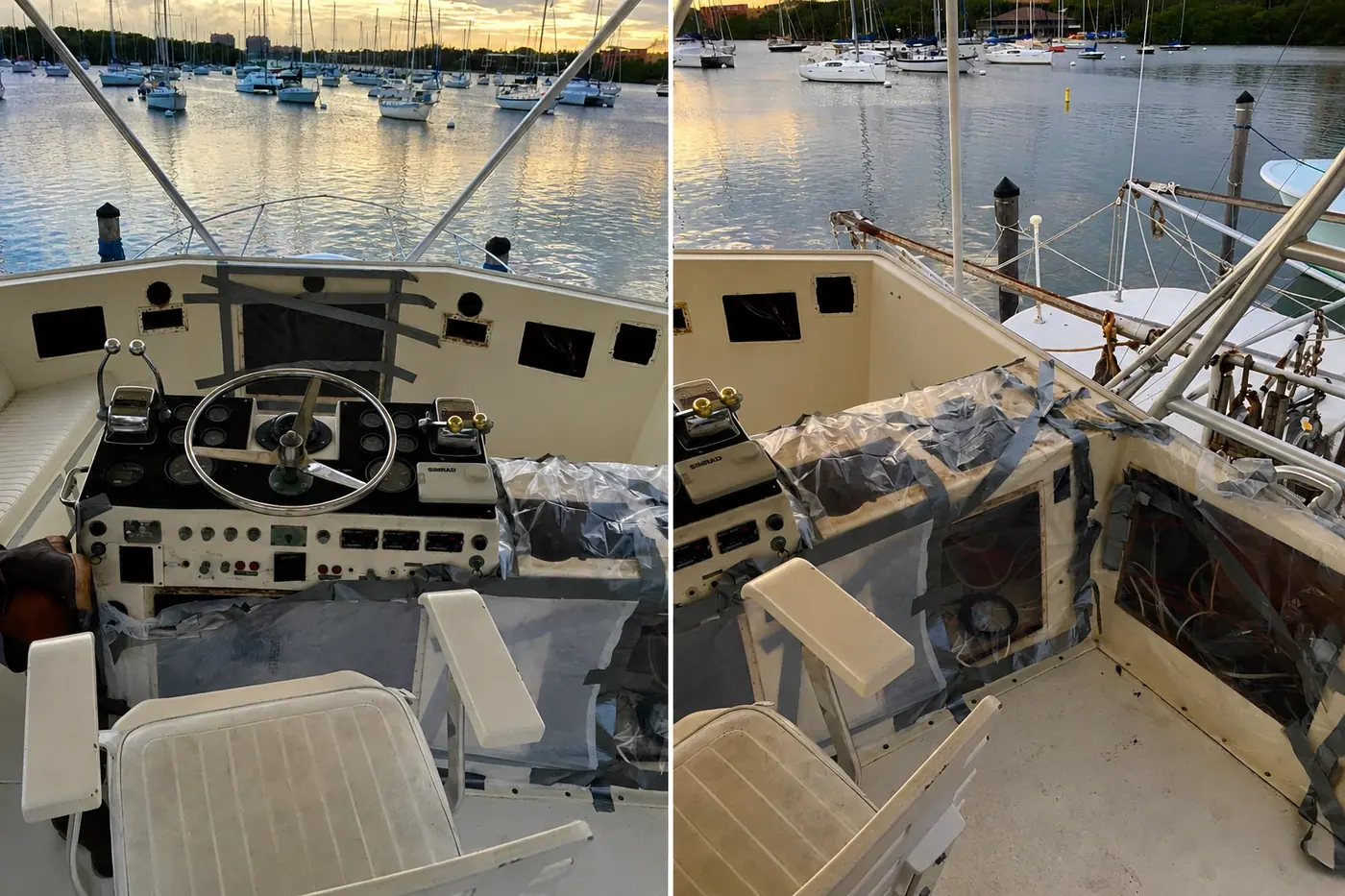
The work started the day after we got to Miami, and the first thing we did was gut the boat. We pulled all the old electronics and spent weeks condemning everything we were not going to keep. The boat had some cool old gear on it, like an old depth recorder that prints on paper, which was still working. I was pretty ruthless in deciding what to keep, so nearly everything ended up in the trash, was sold, or was given away.
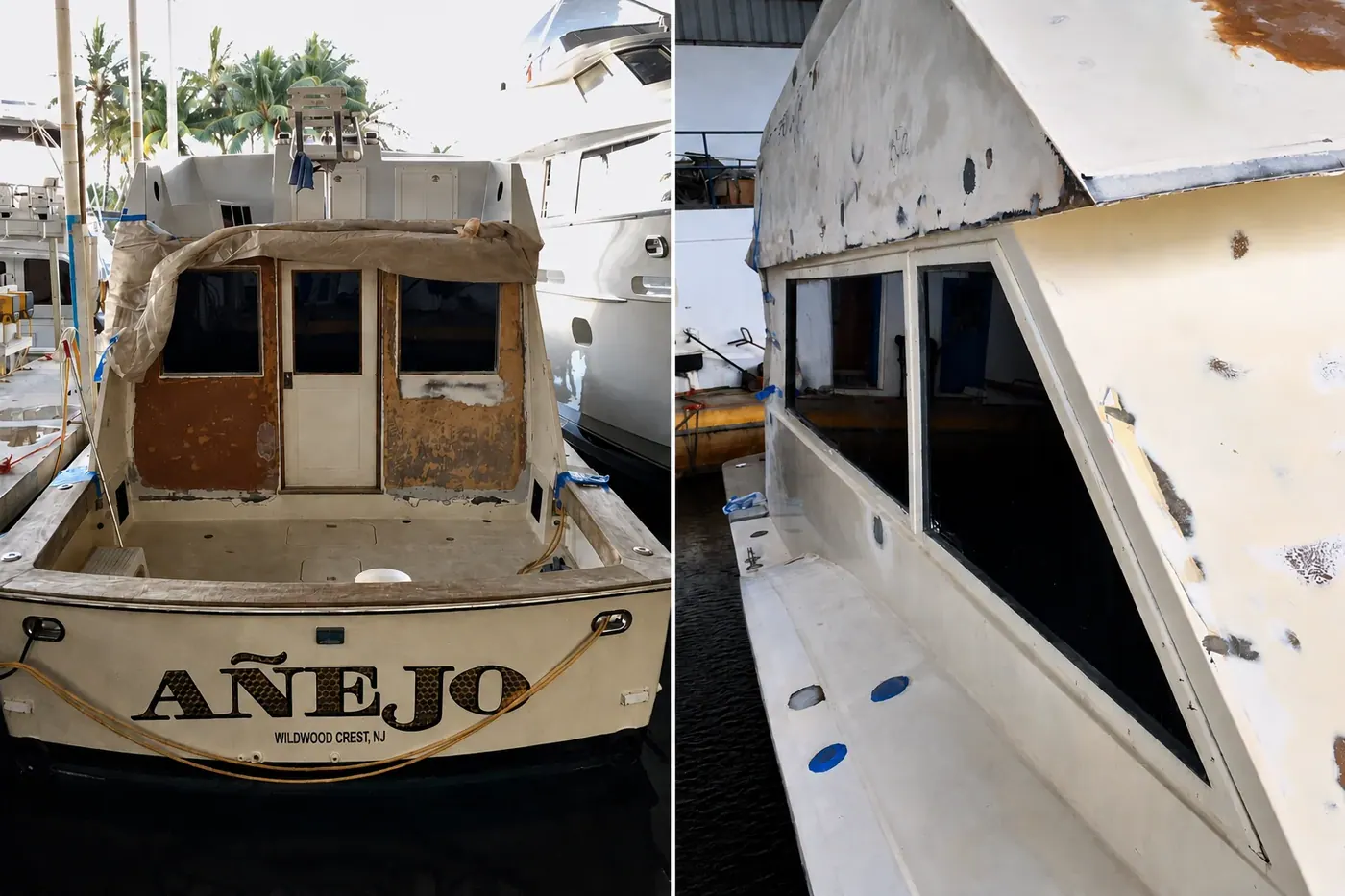
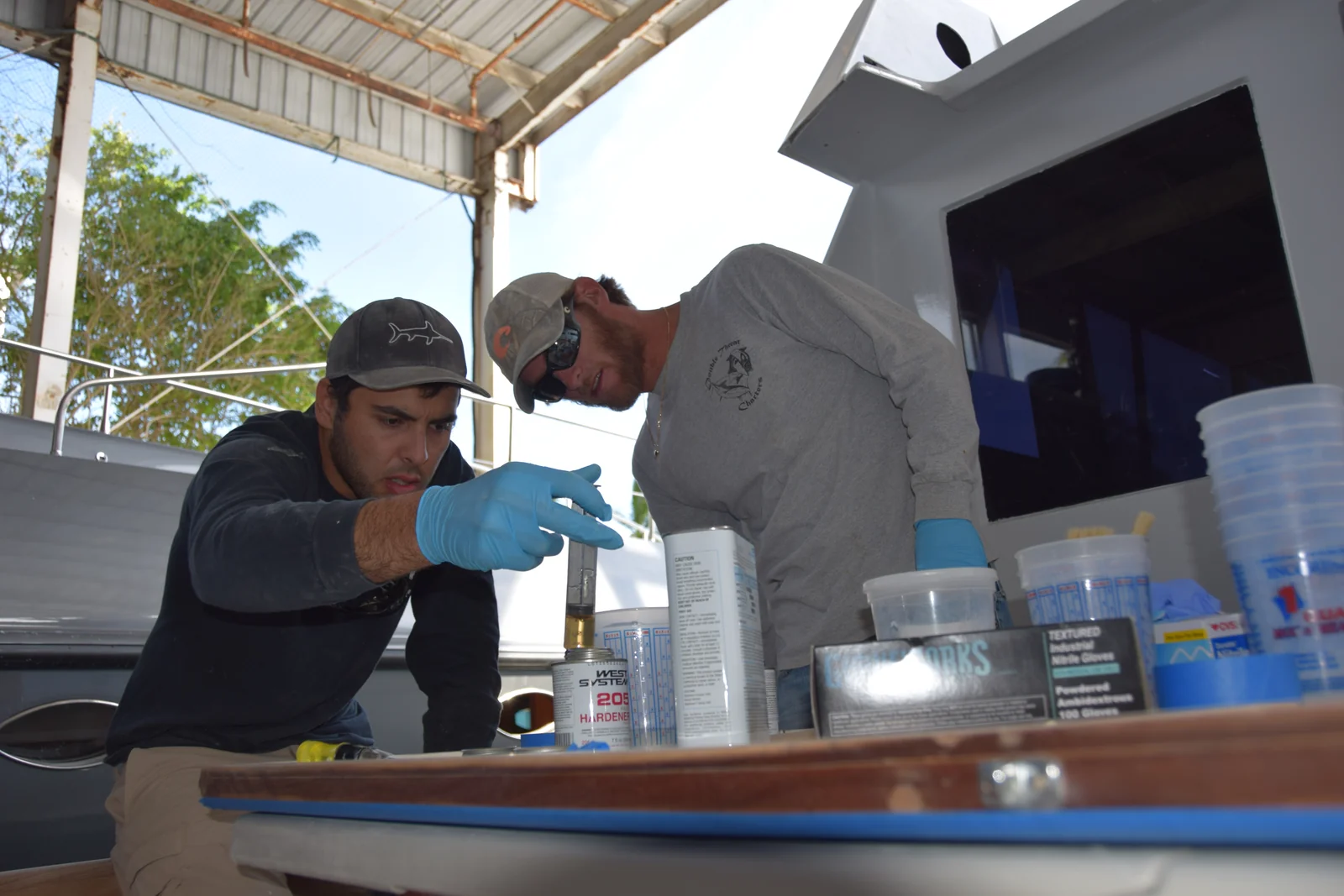
As we started dismantling the boat, we lined up estimates for the tower, the hardtop, the fish box, and the custom livewell. My entire budget was gone with just a few subcontracted items, so it was clear we would be doing a lot ourselves. At the time I did not know how to lay fiberglass or use marine paint, and my electrical skills were sketchy at best. I quickly developed into the head fiberglass guy, the lead painter, the plumber, the one-man electrical department, the general contractor, and the contracted labor. It was clear I did not have enough money to pay others, so everything became an in-house job.
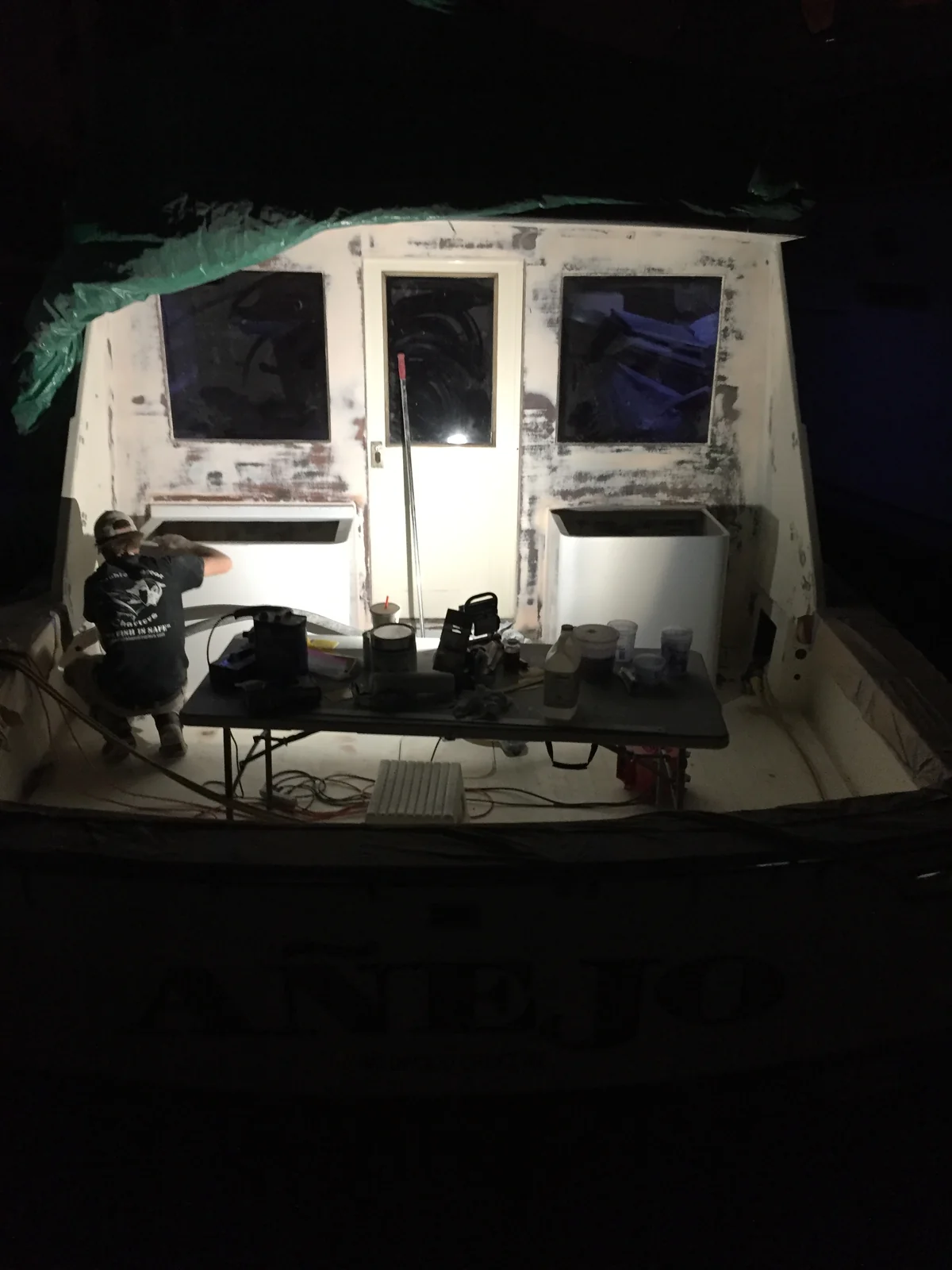
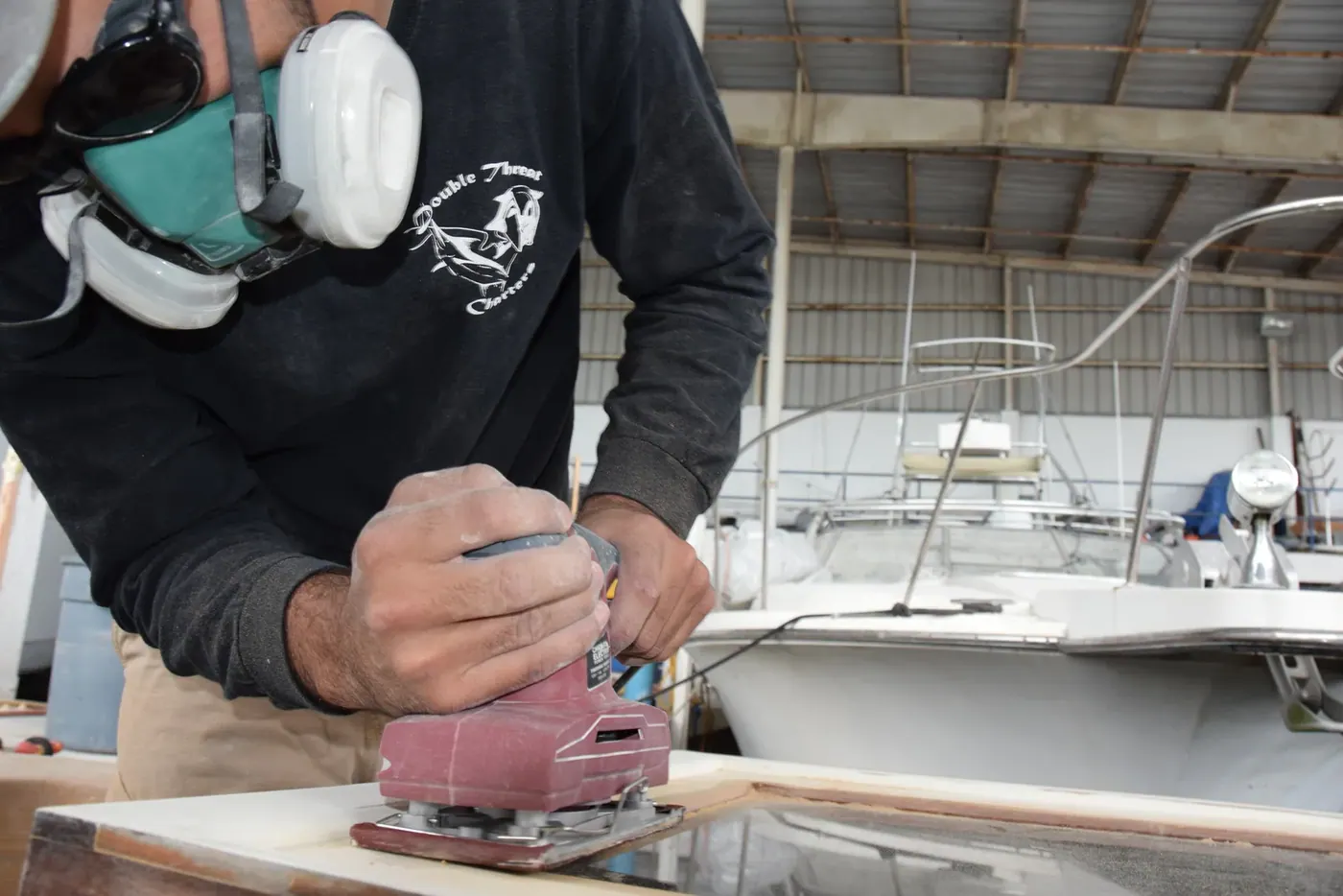
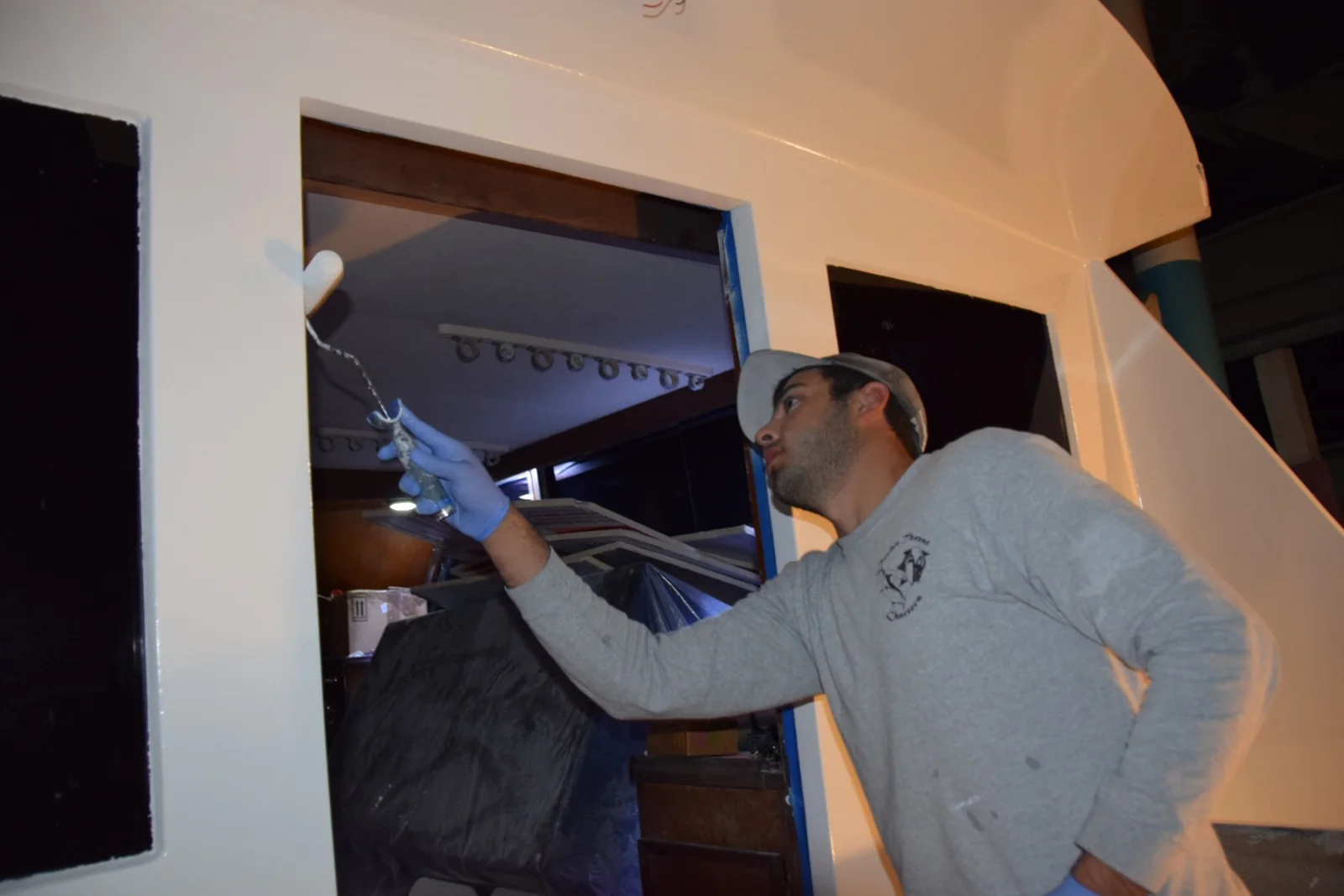
Anyone who has painted knows that prep is everything. When I started sanding the hull I found something like ten layers of paint built up over forty years, so I made the call to take the whole boat down to bare glass and fair it before I ever opened a can of primer. I started with the bridge, because I needed everything operating to move the boat. Ransacking the bridge left me with a lot of holes to fill, so I glassed everything, painted, re-wired the helm and binnacles, and installed the SMX displays. I re-installed the steering during early January, which was good timing because we got kicked out of the marina for doing too much work and had to go to the Miami River to continue the project.
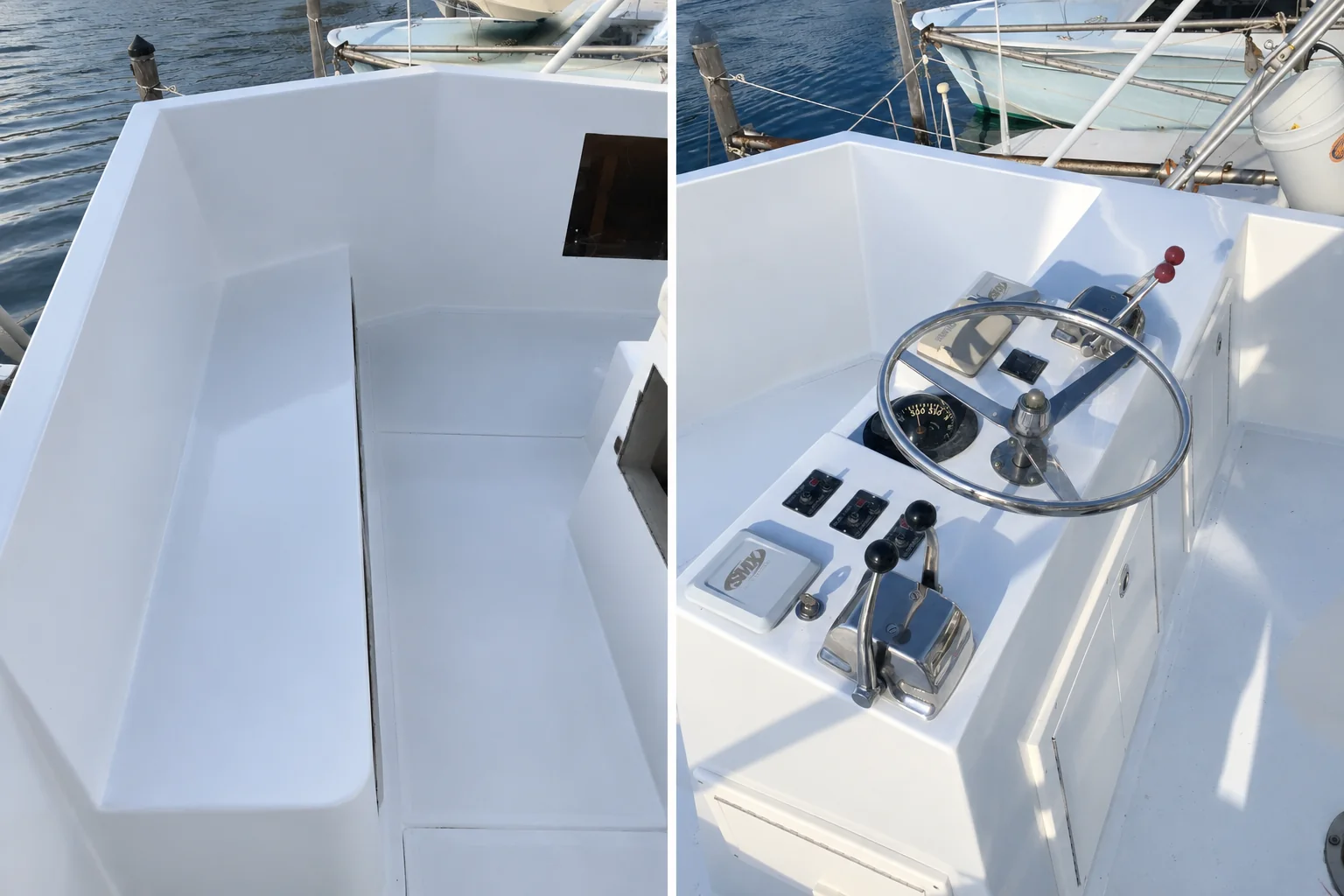
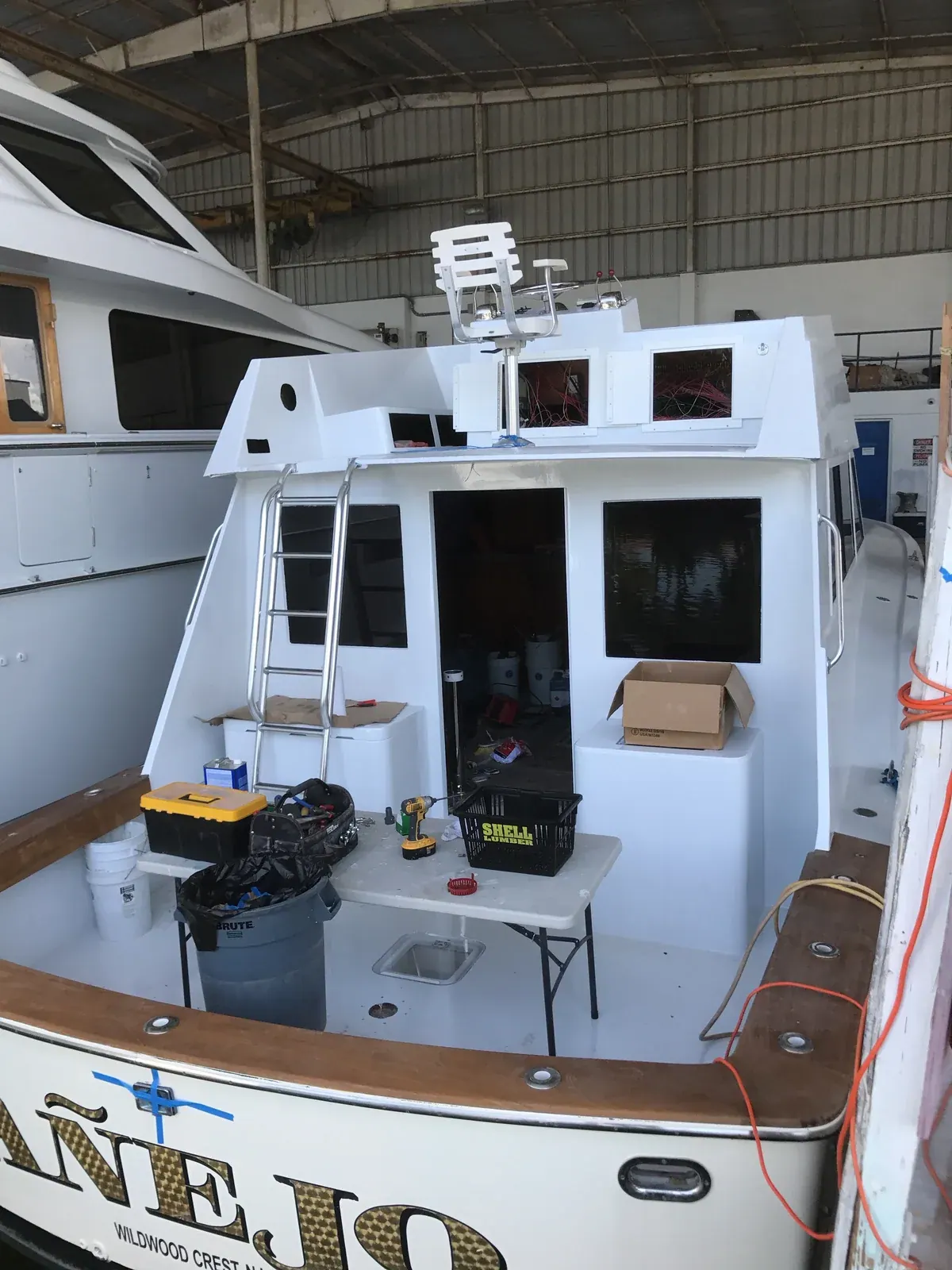
The next three months involved a lot of sanding, fiberglass work, and fairing. The worst of it involved the wooden bulkhead that turned out to be waterlogged. I dug out the rot, glassed the whole thing, and faired the radius until it looked like it came that way from the factory. That one bulkhead took the better part of a month. Next, the fish box and the livewell were delivered and we glassed them in ourselves. After that, we finished painting the cockpit, the house, and the bow. The whole time, I was still running charters on the Blue Yonder to keep money coming in, so a lot of the work happened in the evenings and at night after long days on the water.
The tower
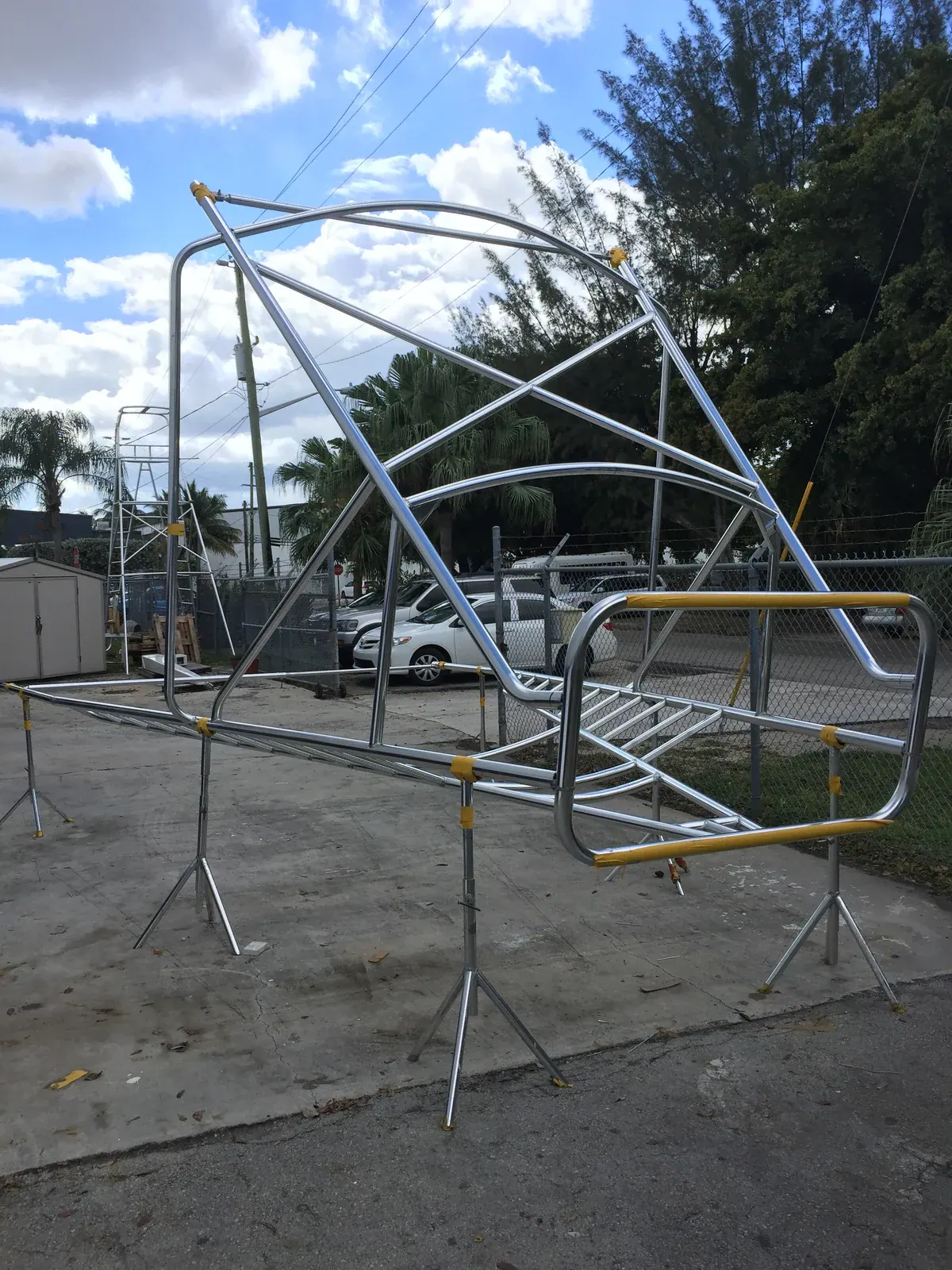
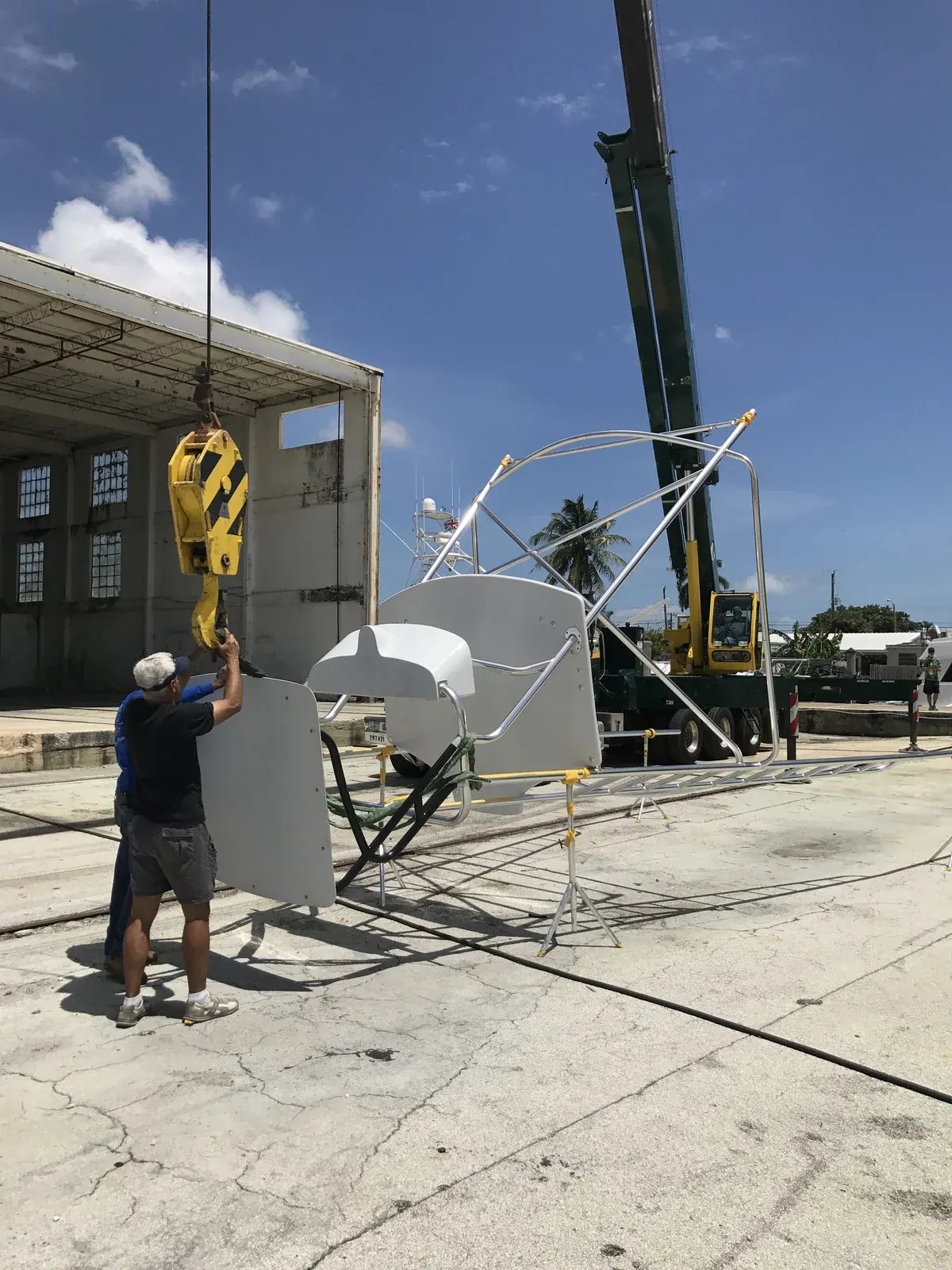
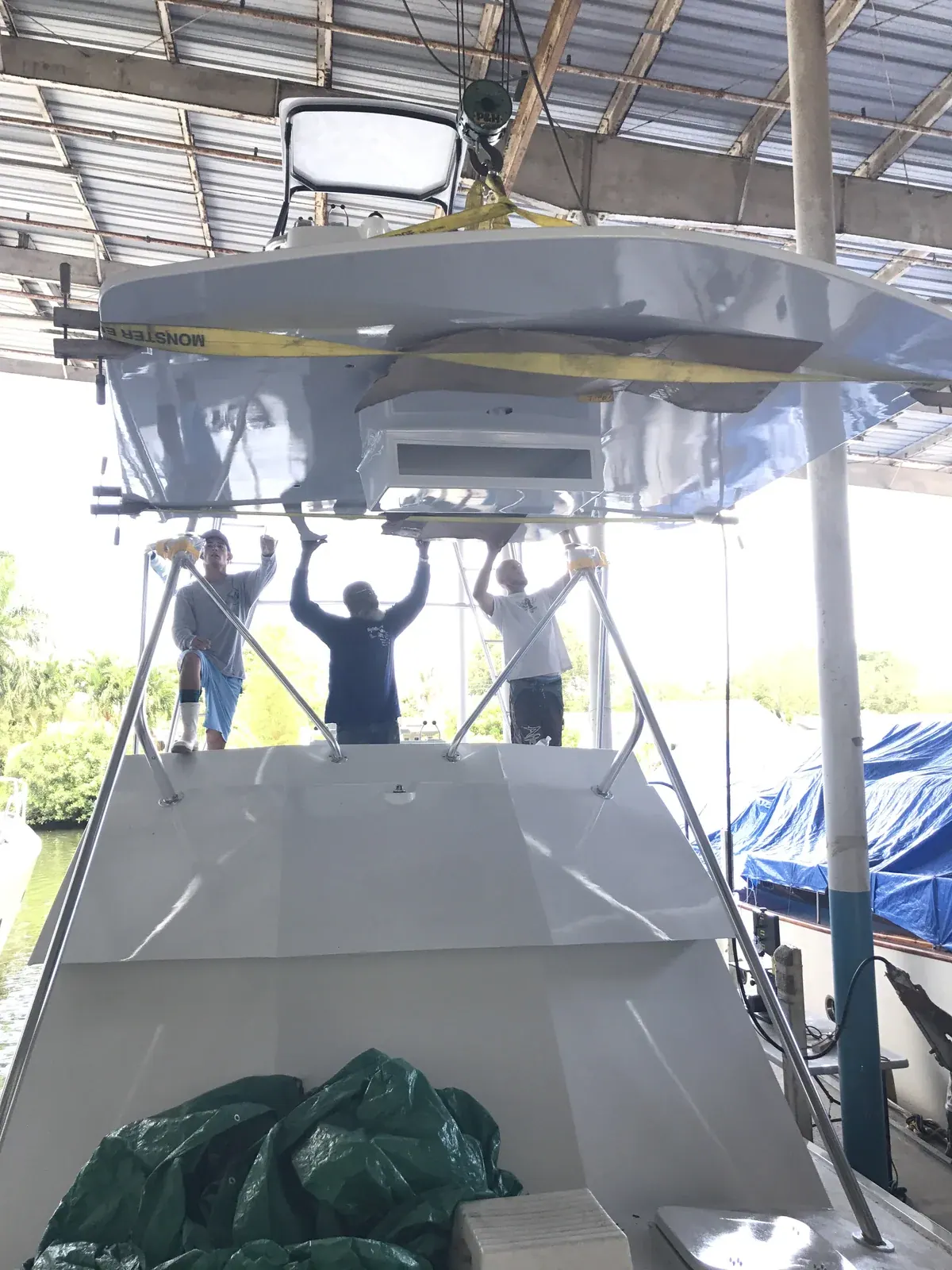
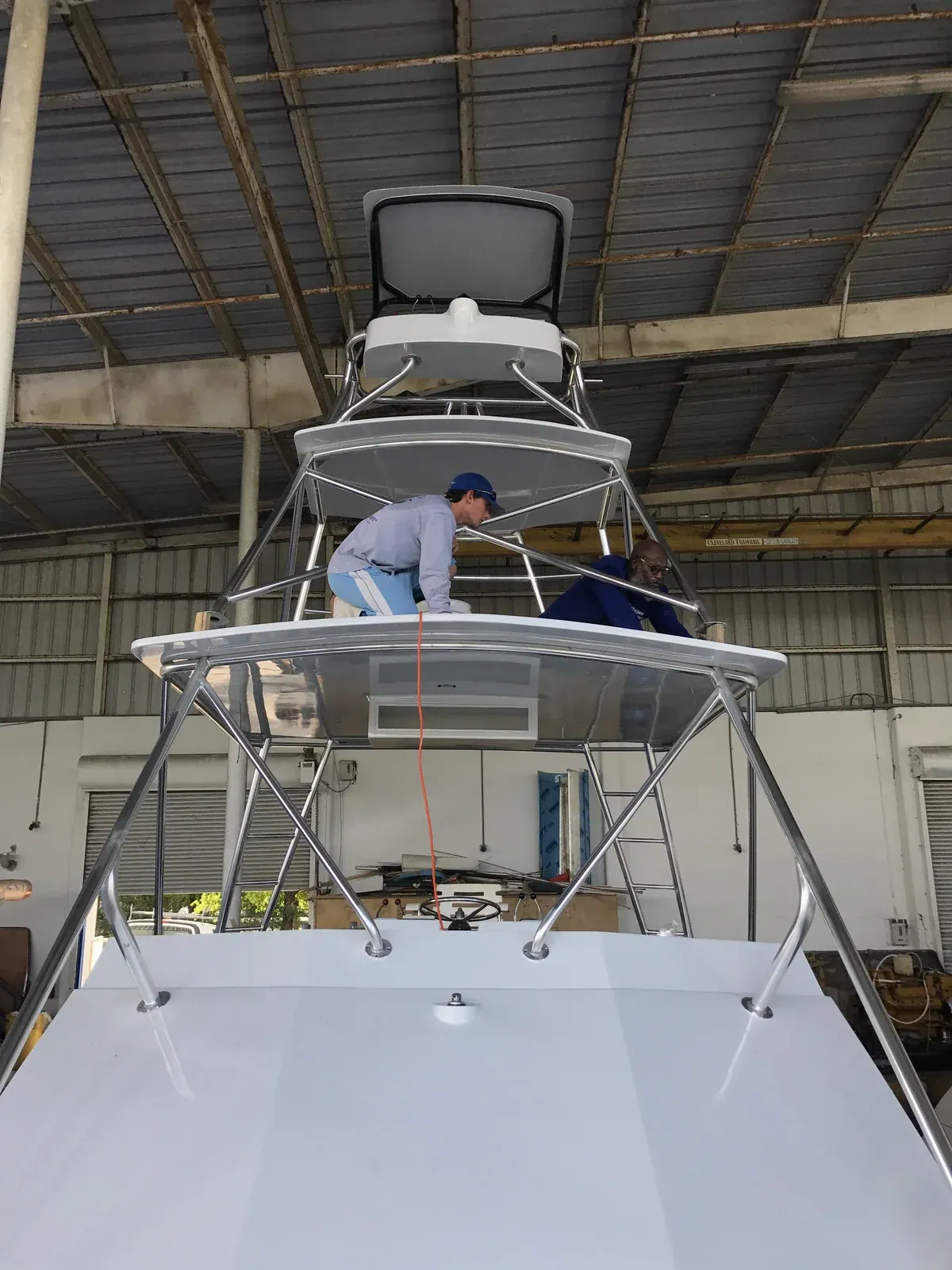
The tower was installed on the thirty-first of May, two days before my birthday, and it was the most satisfying day of the entire project. By then most of the boat was already painted, so watching the tower come together was the first time I could really see the finished boat instead of the work left to do. We set the tower with one crane and the hardtop with a second. Putting the tower on meant another round of work I had been waiting to do, such as installing the electronics in the hardtop, running the cables and the steering up to the second helm, but none of it felt like a chore anymore. The boat was finally beginning to look like the one I had imagined a year ago.
She finally planes
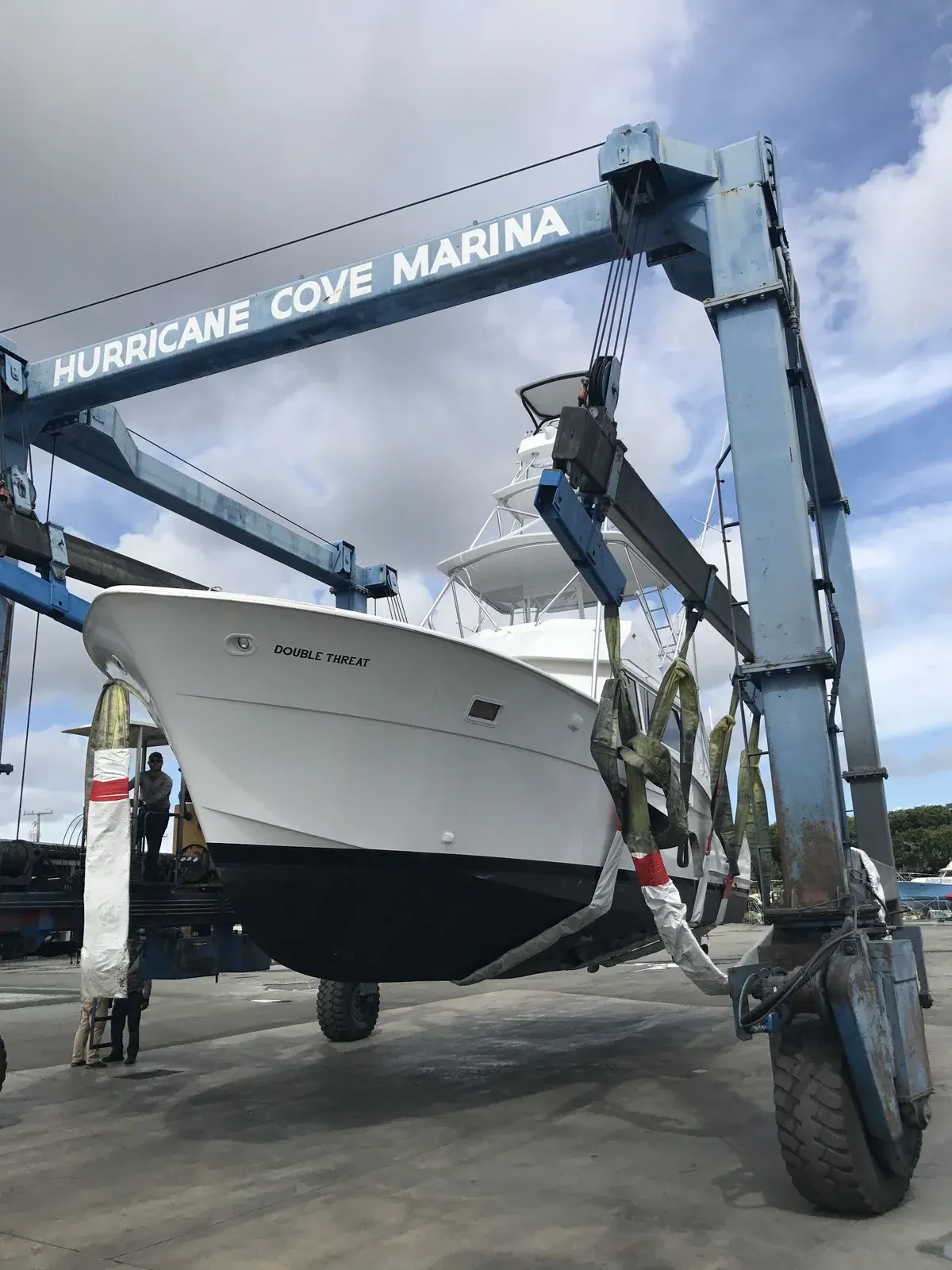
With the tower on, we took her to the yard for the last stretch. We installed the transducer, did the bottom paint, painted the hull, finalized the electronics and the tower rigging, and installed the boat name. We also redid the running gear alignment while in the yard, which turned out to be one of the most important mechanical fixes of the entire project. In all the time I had owned the boat, she had never once been up on plane. When we launched her and left the Miami River on the nineteenth of July, 2017, she finally planed off and ran exactly like I had hoped.
I had spent more than a year with the thought that I might have to rebuild those motors, and all we ended up doing was fixing a fuel leak, replacing the head gasket, and servicing the aftercoolers. That same port motor, the one with the head gasket I limped a thousand miles home on, ran ten thousand hours before it needed a rebuild. The starboard motor is at fifteen thousand hours and it is still running as of July 2026.
Still not done
The initial rebuild was one of the most difficult periods of my entire life. We have run more than three thousand trips on the boat since 2017 and the projects have only continued over the years. In 2021 we took the interior all the way back down and rebuilt it, so she is as comfortable inside as she is capable on the water. The Double Threat is a never-ending passion project and we are coming up on some 2026 renovations that will be some of the most substantial yet. We will be installing a Seakeeper 6 gyro stabilizer, painting the entire boat inside and out, and installing Glendinning electronic controls. Our hope is to make the boat one of the most comfortable and comprehensively retrofitted 1972 hulls you will ever set foot on. She will always be a work in progress, but each version of the Double Threat has been one that we are proud to share with our guests.